

Viva Voce
THE LABORA COLLECTIVE · A DIOSA ARA INITIATIVE

THE ECONOMIC BODY / SEND 6
VIVA VOCE · {{current_date_full}} · READ-ALOUD FROM THE LABORA COLLECTIVE
SEND 6 OF 21
A prohibition is not a procedure
Karina Gonzalez did everything we tell women to do, every agency did its job, and no one was ever sent to take the gun.
DR. YAMICIA CONNOR, MD, PHD, MPH
KARINA GONZALEZ
In the summer of 2023, in Chicago, a woman did every single thing we tell women to do.
On 20 June 2023, Karina Gonzalez left her home in Little Village with her children and went to stay with family. The next day, 21 June, she went to court and was granted an order of protection against her husband, Jose Alvarez. She cited his drinking, his drug use, and his threatening behaviour. A judge gave her exclusive possession of the home, barred him from the property, and barred him from contacting her.
Jose Alvarez owned a Glock 17. He had a valid FOID card — the Illinois firearm owner's card — and the order of protection revoked it automatically.
Now watch the machinery, because every part of it did its job and the outcome was still four bullets short of nothing.
23 June: a Cook County sheriff's deputy went to serve him. He was not home. Also on 23 June, the Illinois State Police matched the order to his FOID record and suspended the card.
24 June: the state police notified the Chicago Police Department and the Cook County sheriff of the suspension. Chicago police later said their firearm investigation team never received that notification.
And under Illinois law as it then stood, the next step was his. He was required to fill out a form accounting for his weapons and hand them over himself. The state revoked his card. The state did not go and get his gun.
A day after the order was granted, Chicago police answered a domestic disturbance call at that address. There is no indication the officers knew the order existed.
26 June: Karina and the children went home, on the understanding that he would enter rehabilitation.
3 July: he began accusing her of cheating, as he had for years. She told him to stop and sat down with her children in the living room. Her son told him to stop, or he would call 911, and walked toward his room. Alvarez went past him and got the gun.
He shot Karina eight times. She died at home. He shot their fifteen-year-old daughter Daniela in the face and the forearm; she was still breathing when police arrived and died at Mount Sinai. He fired under the dining table at his son, who was shielding himself with a chair, and hit him in the ankle. The son ran out of the apartment and called the police. A surveillance camera captured fourteen shots. Officers found the handgun on his bed.
Karina Gonzalez was forty-eight years old. She had an order of protection. His card had been revoked. Nobody came for the gun.
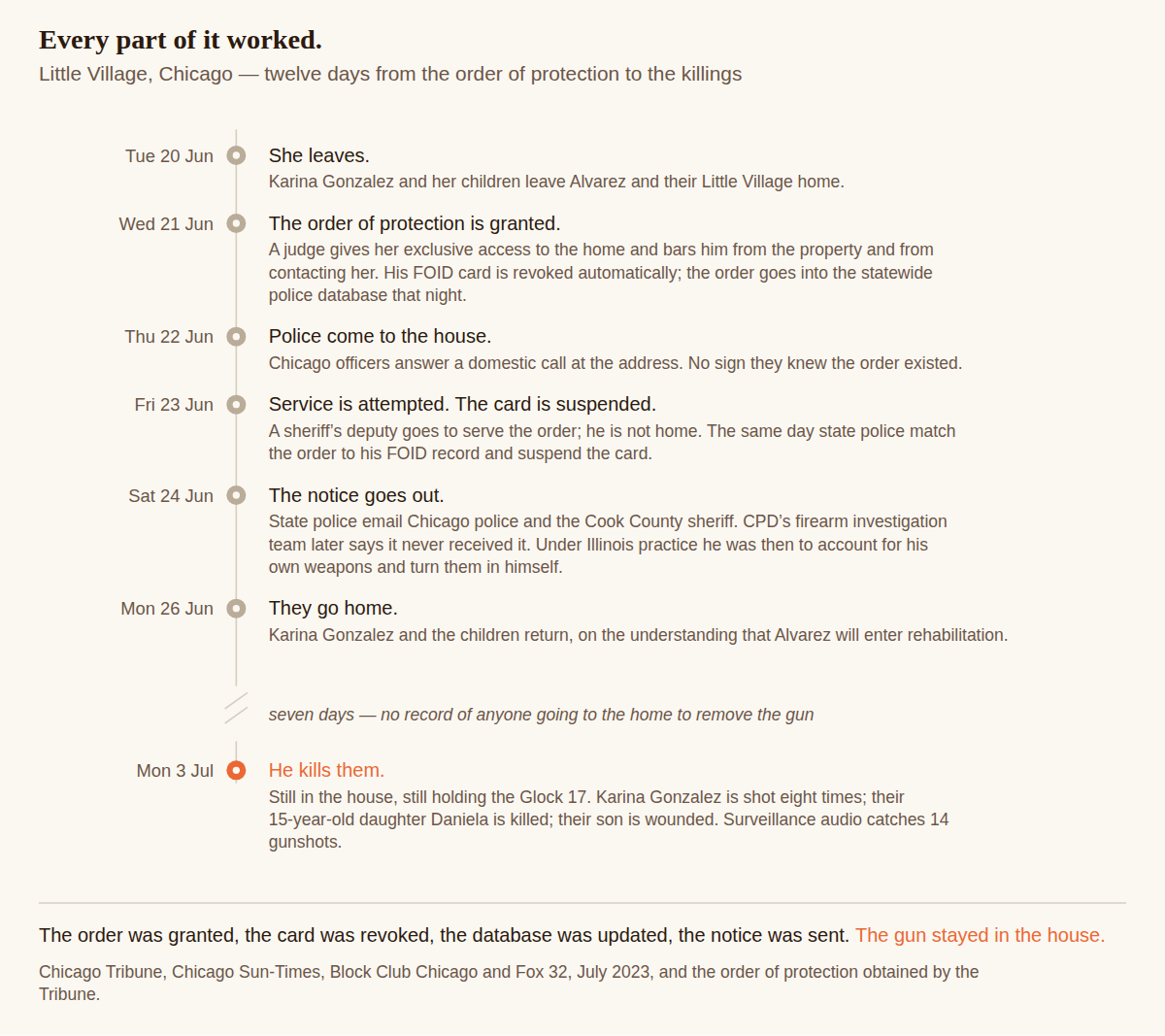
Every part of the machinery did its job. Karina Gonzalez died anyway.
A PROHIBITION IS NOT A PROCEDURE
We say Rahimi as though everyone knows what it is. Zackey Rahimi was subject to a Texas domestic violence restraining order after assaulting his girlfriend in a parking lot, and was charged under the federal statute barring anyone under such an order from possessing a firearm. He argued it was unconstitutional. In 2024, the Supreme Court disagreed and left it standing.
That was a win. Here is the sentence that turns it into a silent refusal.
The law does not tell anyone to go and get the gun.
Whether the gun actually leaves the house is a question of state procedure, and that procedure is made of specifics. Who serves the order. Whether an inventory is taken. How many hours he has. Which officer collects it. What happens if he says he does not have one. Where a state has not written those steps, the prohibition exists, but the gun stays where it is.
IN THE NEWS
United States v. Rahimi (2024)
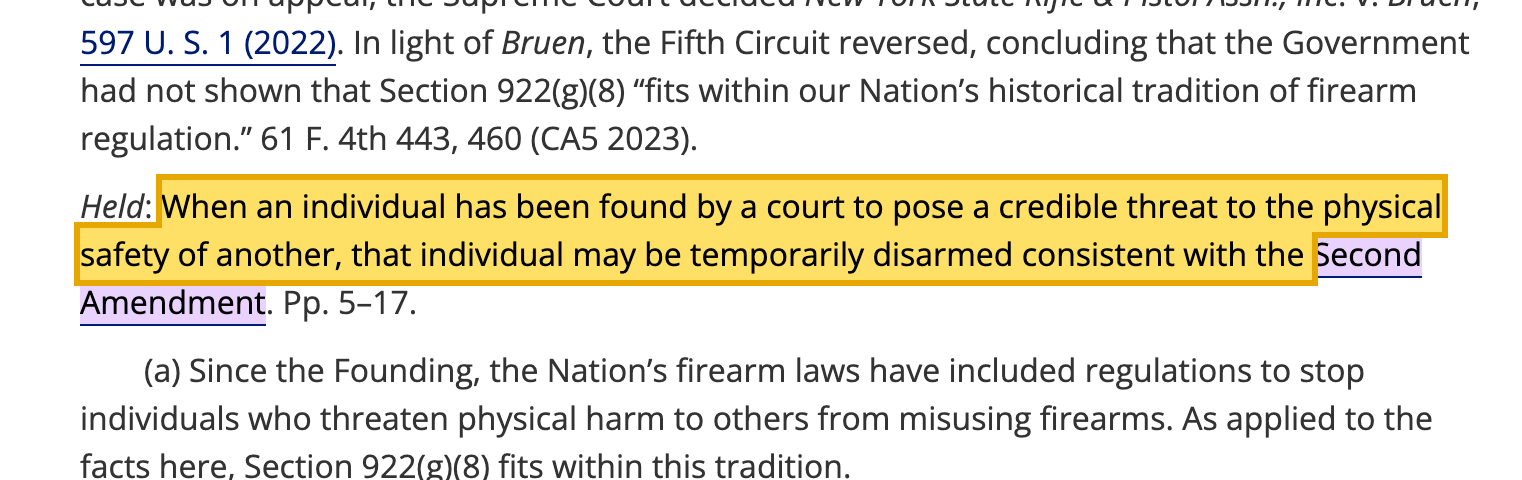
This is the case the chapter calls a win. Read what it actually held, and notice what it does not say.
In United States v. Rahimi (2024) the Supreme Court upheld 18 U.S.C. 922(g)(8), barring firearm possession by a person under a qualifying domestic-violence restraining order.
FROM OUR FOUNDER, SERIALLY
The Gunman in the Room · 3 of 6
Every part of the Karina Gonzalez case worked exactly as it was designed to, and she still died of it. The essay below names why a working process routinely fails the same women anyway: the calculation happens beneath the level of anyone deciding to make it.
The Mechanism
This is not a claim about bad intentions. It is a claim about what the data shows happens in clinical settings when the patient is Black.
In 2016, researchers published a study in PNAS documenting that 50% of White medical students and residents endorsed at least one false belief about biological differences between Black and White people — that Black people's skin is thicker, that their blood coagulates more quickly, that they feel less pain. Those who endorsed these beliefs rated Black patients' pain as lower and made less accurate treatment recommendations.
The consequences downstream are measurable. Black patients presenting with extremity fractures receive analgesics at a rate of 57% versus 74% for White patients. A meta-analysis of 14 emergency department studies found Black patients were 40% less likely to receive analgesia for equivalent pain. For obstetric settings specifically: a 2023 KFF survey found that 22% of Black women who had been pregnant in the last decade reported being refused pain medication they believed they needed. Twenty-two percent.
Now add the power asymmetry. A 2024 study published in Science — using 1.5 million quasi-random physician-patient assignments in military emergency departments, where military rank provides an exogenous measure of patient power — found that high-power patients who outranked their physician received 3.6% more diagnostic effort and resources, and had a 15% lower likelihood of hospital admission in the following 30 days. White physicians consistently invested less effort in Black patients. Black patients who outranked their White physician received more effort — but still less than equivalent White patients.
This is the mechanism. Patient power — perceived social status, authority, the visible weight of consequence for dismissing this person — changes what a physician does. Not always consciously. But measurably, causally, with life-or-death downstream effects.

Read the whole essay in one sitting →
WHAT YOU ARE A PART OF · 6
This Isn't Idealism
If you are tired of waiting for this work to be done by someone else, you are not alone. Patients, providers, policymakers, parents — you deserve better than the version of healthcare you have inherited.
We can rewrite the rules. We can fund the research that matters. We can train clinicians to listen and to escalate. We can stop accepting maternal mortality numbers as a national identity.
This is not idealism. It is survival. It is the difference between a future in which women die because their symptoms were dismissed and their biology was misunderstood, and one in which they don't.
We've waited long enough.
— Dr. Yamicia Connor, Founder, Diosa Ara
THE ASK
An obstetrician in the room.
Diosa Ara is an obstetrical emergency company. More than a third of American counties have no hospital that delivers babies, and the hospitals that closed their labor units are still required by law to handle a woman who arrives in labor, with no one there who can. We are building the infrastructure that puts an obstetrician in that room when it counts. Your subscription is what pays for it.
UPCOMING
2 October · Architecture of Harm · Live · Ep. 7 · Chapter 4 · Disease Acceleration
12 October · Pregnancy & Infant Loss Awareness — Remembrance window (Oct 15)
WATCH THE LIVES
Every live from The Economic Body is on the series site, with the deck from each one that has aired.
The Economic Body — the lives, and the deck from each one →
To see the full schedule — the Collective calendar →
NEXT
Twenty-two states require an abuser under a restraining order to hand over his guns. Twenty-eight do not.
Thank you for being here. Forward this to one person who needs the spine.
— YC
Dr. Yamicia Connor, MD, PhD, MPH · Founder & CEO, Diosa Ara | Creator & Editor-in-Chief, The Labora Collective
A Labora Collective Publication — part of the Diosa Ara ecosystem