

Viva Voce
THE LABORA COLLECTIVE · A DIOSA ARA INITIATIVE

THE ECONOMIC BODY / SEND 3
VIVA VOCE · {{current_date_full}} · READ-ALOUD FROM THE LABORA COLLECTIVE
SEND 3 OF 21
What the state actually owes you
Property has an ascertainable monetary value, so property gets a procedure. Her children did not.
DR. YAMICIA CONNOR, MD, PHD, MPH

WHAT THE STATE ACTUALLY OWES YOU
She sued the town. The case went to the Supreme Court as Town of Castle Rock v. Gonzales, decided on 27 June 2005, seven to two, with Justice Scalia writing.
She lost.
The holding was that she had no property interest in police enforcement of her own restraining order. The words on the back of the form — YOU SHALL ARREST — did not make enforcement mandatory, because, in the Court's words, "a well-established tradition of police discretion has long coexisted with apparently mandatory arrest statutes." And: "the creation of a personal entitlement to something as vague and novel as enforcement of restraining orders cannot simply go without saying."
Then there is this sentence. The Court said the order had value anyway, because it made his conduct criminal — "even if the prospect of those sanctions ultimately failed to prevent him from committing three murders and a suicide."
Castle Rock rests on DeShaney v. Winnebago County, decided in 1989, which had already answered the larger question: "nothing in the language of the Due Process Clause itself requires the State to protect the life, liberty, and property of its citizens against invasion by private actors." The clause exists, the Court said, "to protect the people from the State, not to ensure that the State protected them from each other."
And look at what the Court had to reach for to get there. The whole case turned on whether enforcement of her order was a property interest. The Court said it could not be one, because such a right "would have no ascertainable monetary value."
Sit with that sentence. Her three daughters' lives were weighed against whether what she was owed counted as property, and the answer was no — because you cannot put a dollar figure on it.
Now think about what the state does protect. If a man takes your car, the police come. If a man takes your television, there is a report, a case number, an investigation, a detective. Property has an ascertainable monetary value, so property gets a procedure. Her children did not.
The state has more desire to protect your physical property, and spends more of its resources protecting your physical property, than it does the life and safety of your children. And to consider police protection an entitlement — as if it were something extra you were asking for.
So I want to ask the obvious question out loud, because nobody asks it. What are our taxes for? What are we entitled to as citizens of a nation if not police protection? If it is not that, what is it? Why do we subjugate ourselves to these people?
So the state has no constitutional duty to protect you from him, and your restraining order does not create one.
Jessica Gonzales — she is Jessica Lenahan now — took the case to the Inter-American Commission on Human Rights. In 2011, it found that the United States had violated her human rights and her daughters'. It changed nothing in American law.
Hold that under everything that follows. A prohibition with no procedure attached is not an oversight in a system that otherwise owes her protection. It is exactly what you would expect from a system that has told her, twice, that it owes her nothing.
AND IF SHE IS NATIVE, IT IS WORSE
The same principle, applied to Native women, produced something even harder.
In 1978, a non-Native man named Mark Oliphant assaulted a tribal police officer on the Suquamish Port Madison Reservation in Washington. Tribal police arrested him. He argued the tribe had no authority over him because he was not a member. The Supreme Court agreed, six to two, in Oliphant v. Suquamish Indian Tribe: tribal courts cannot prosecute non-Indians unless Congress explicitly says they can.
Here is the number that turns that from a jurisdictional technicality into a policy about women's bodies. Ninety-seven percent of American Indian and Alaska Native women who are victims of violence were harmed by someone of another race. For white victims, the figure is thirty-five percent. Oliphant removed tribal authority over almost precisely the population committing the violence.
It took thirty-five years for a partial repair. VAWA 2013 restored a limited tribal criminal jurisdiction over non-Indians for domestic and dating violence — people call it the Oliphant fix — and 2022 extended it to certain sexual offences. It is still limited, still conditional on the tribe meeting federal procedural requirements, and still leaves the assailant with no qualifying relationship outside tribal reach.
Remember that when we get to the money.
THE LEVER
Here is what the research has shown for years and what we watch play out on labor floors. When the economy contracts, the violence expands. When unemployment rises fast, controlling and abusive behavior increases — not only from household hardship, but from the fear and instability the downturn carries into the home and into the man himself.
The economy is not the backdrop to this violence. It is the lever on it. And in 2025 and 2026 that lever is being pulled hard, in the worst direction, from two sides at once.
A SERIES, SERIALLY
They Called It Suicide · 2 · The door that locks
The Court told Jessica Gonzales that what she was owed had no ascertainable value, and that ended it. There is a version of that sentence for the dead.
In Florida, the autopsy report of a person whose death is ruled a suicide is confidential by statute. It is exempt from public records and withheld from the family unless a court orders otherwise. The ruling most in dispute is the one ruling that seals the one document that could test it. The family that most needs to see the evidence is, by operation of law, the family least permitted to.
The reliable way into a sealed file is a lawsuit. Wrongful-death discovery compels documents into the open. That is how the Willie Jones family got a court to weigh their account at all, and it took money, a lawyer willing to take the case, and years. Jessica Gonzales also had to sue to find out what she was owed. The answer to her was nothing. The answer to the Jones family was eleven million dollars from a civil court and no charge from the state. That is the same answer. The state will let a private court put a price on your dead, and it will not lift a finger itself.

The whole argument, in one piece →
FROM OUR FOUNDER, SERIALLY
The Gunman in the Room · 1 of 6
The Court's reasoning had a shape. What the state protects is what has a price, and a woman's safety has none, so it is not protected. I wrote The Gunman in the Room before there was a series or a newsletter. It is the essay Diosa Ara is built on, and it is about the same shape inside a hospital: the women the institution is oriented away from, whom no income, no degree and no advocate can buy back in. It runs here whole, a section at a time. This is the first.
There is a trillion dollars flowing toward maternal health innovation in the United States right now. Blood pressure monitors. Remote monitoring platforms. Prenatal apps. Postpartum check-in tools. AI-powered risk stratification. The investment is real, the technology is often excellent, and almost none of it is going to solve the problem.
I want to explain why. Not as an argument against those companies — I genuinely want them to succeed. I want to live in a world where maternal health technology is the undisputed frontier. But we cannot get there yet. Understanding why requires being willing to follow the data to a conclusion that most people in this space have not been willing to say out loud.

Read the whole essay in one sitting →
SHARE THIS
Oliphant, 1978
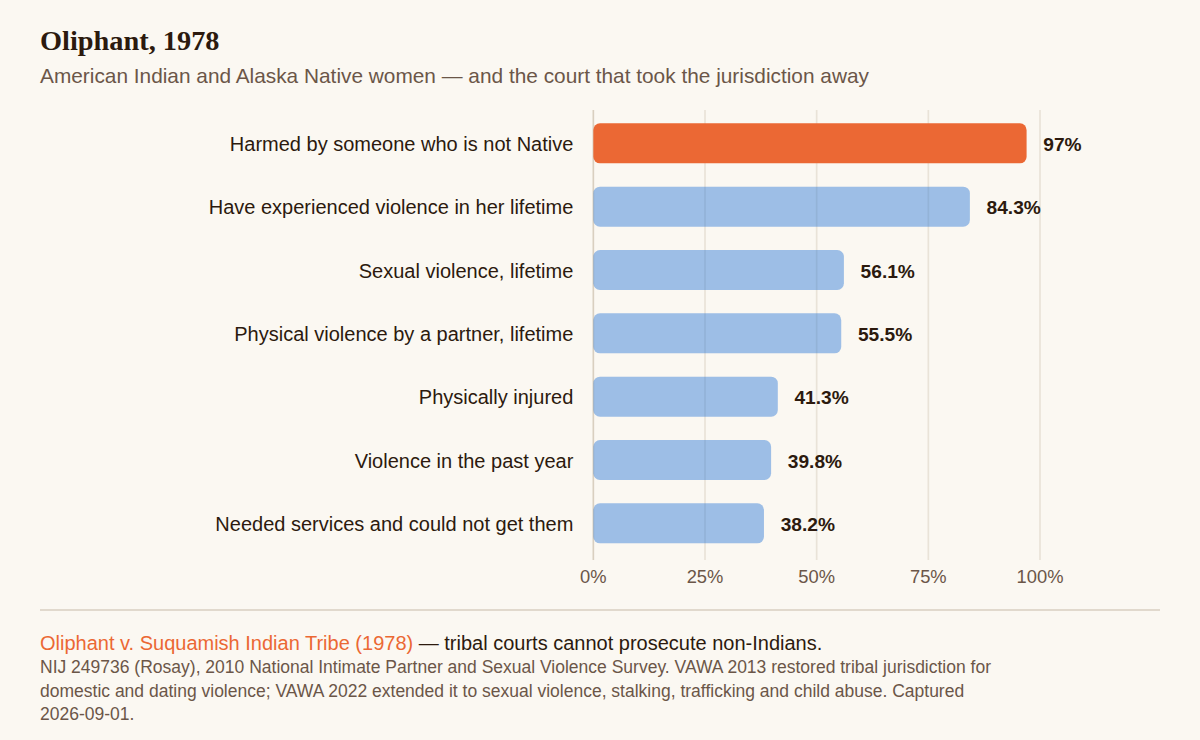
The card for this send, from the registry
WHAT YOU ARE A PART OF · 3
The System Was Not Built for Us
Women were excluded from most clinical trials until the 1990s. The justification was always biological complexity — the menstrual cycle, the possibility of pregnancy, the inconvenience of variability. The result is that we still extrapolate dosing, side-effect profiles, and disease progression from male bodies, then act surprised when women have worse outcomes on drugs that were never validated in them.
The exclusion isn't symmetric. Black women in the United States are three to four times more likely to die from pregnancy-related causes than white women. That gap doesn't close when you control for income. It doesn't close when you control for education. The gap is racism — the everyday clinical version, embedded in who gets believed, who gets imaged, who gets escalated.
We have built a healthcare system on top of centuries of erasure. We are living with the consequences and asking why outcomes are bad.
THE ASK
An obstetrician in the room.
Diosa Ara is an obstetrical emergency company. More than a third of American counties have no hospital that delivers babies, and the hospitals that closed their labor units are still required by law to handle a woman who arrives in labor, with no one there who can. We are building the infrastructure that puts an obstetrician in that room when it counts. Your subscription is what pays for it.
UPCOMING
23 September · Boards · 024 · Fetal Growth Restriction
23 September · Boards · 025 · POP-Q
To see the full schedule — the Collective calendar →
WATCH THE LIVES
Every live from The Economic Body is on the series site, with the deck from each one that has aired.
The Economic Body — the lives, and the deck from each one →
To see the full schedule — the Collective calendar →
NEXT
The trap with no exit. She cannot rent a place to be safe in, and the scaffolding that stood in for money is being pulled.
Thank you for being here. Forward this to one person who needs the spine.
— YC
Dr. Yamicia Connor, MD, PhD, MPH · Founder & CEO, Diosa Ara | Creator & Editor-in-Chief, The Labora Collective
