

The Signal
THE LABORA COLLECTIVE · A DIOSA ARA INITIATIVE

THE ECONOMIC BODY / SEND 10
THE SIGNAL · October 21, 2026 · WEEKLY CLINICAL INTELLIGENCE
SEND 10 OF 21
She talked for thirty-five minutes
The visit was supposed to take fifteen minutes, until I asked how things were at home and left the room quiet enough for her to answer.
DR. YAMICIA CONNOR, MD, PHD, MPH
THE ROOM
The complaint on the schedule was right-flank pain in a pregnant patient with a history of recurrent urinary infections. Her labs pointed to a kidney infection starting to smolder — the kind of pyelonephritis I do not take lightly in pregnancy, because it runs to preterm labor and sepsis faster than people expect. The visit was supposed to take fifteen minutes.
I told her what the labs showed, what we were going to do, the antibiotics, the follow-up cultures, the point at which I would have to admit her. She nodded. She asked good questions. She had the manner of a woman who had been through enough medical visits to know how to sit in one.
Near the end, when the urinary-tract work was done, I asked a question that was not on the agenda. I asked her how things were at home. I asked it in the same voice I had used to ask about her sleep and her contractions. I did not load it. I did not announce a screening tool. I asked, and then I left the room quiet enough for her to answer.
SHE TALKED FOR THIRTY-FIVE MINUTES
What I learned, distilled: she is in a chronically dangerous situation, not an acutely dangerous one. There is a partner. There is another person who has been violent toward her in concert with him. The threats got worse during the pregnancy and now include an older child she is responsible for. There are weapons in the house. On any honest look at her finances, she cannot leave. She has tried before, and it did not hold.
The shape of it is one every clinician who has done this work has heard: a woman not presenting with an injury, but a woman being eroded. A woman for whom "are you safe at home" is not a yes-or-no question, because the answer has been no for so long that safe and home no longer mean what they mean in a discharge instruction.
I told her that the number one cause of death for pregnant women in this country is homicide. Not to frighten her — she did not need frightening — but to give her situation the language it deserved, and to say plainly that the language was not an exaggeration.
IN THE NEWS
A gun in the abuse, ten years on
New on 29 September in JAMA Network Open: a study that followed women first met in prenatal clinics for up to ten years, asking what a gun or other weapon in the abuse does to them afterwards.

FROM OUR FOUNDER, SERIALLY
The Gunman in the Room · 5 of 6
She talked for thirty-five minutes because I left the room quiet enough to let her. The essay below names the same asymmetry from another door in the same building — a system with every tool already in hand, calibrating in secret how hard to use them, and for whom.
The Power Asymmetry Is the Problem
I want to be precise about what I mean by power asymmetry, because it is not a theoretical concept. It is a clinical variable with measurable effects on outcomes.
The research is now conclusive that patient social status shapes physician effort. Patients perceived as higher-status receive more thorough diagnostic workups, more information, more communication, more treatment adherence. Patients perceived as lower-status receive less of all of these — not because of insurance differences or access differences, but because the physician in the room is unconsciously calibrating their effort to the perceived weight of consequence for failing this particular patient.
For Black women, that calibration runs against them at every level. False beliefs about their physiology. Implicit biases that rate their pain lower. A historical context in which their suffering has been structurally deprioritized. And a physical environment — because 35% of US counties are now maternity care deserts with no birthing facility and no obstetric clinician, and because 117 rural labor and delivery units have closed since 2020 at a rate of two per month — in which the nearest hospital may be 30 or 50 miles away, staffed by clinicians spread thin across patients they cannot adequately serve.
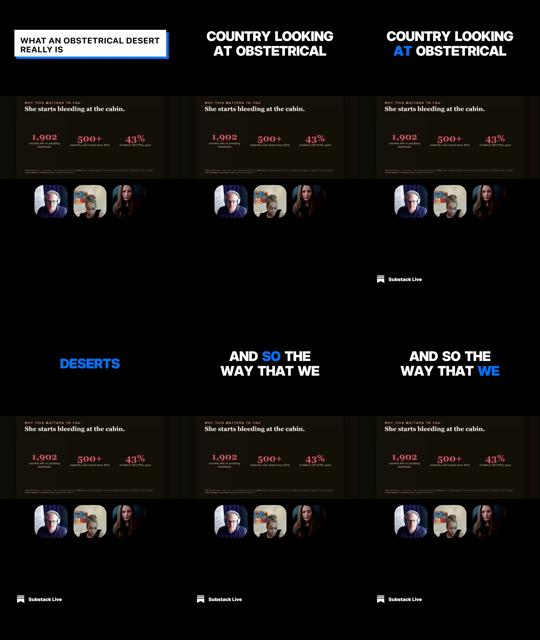
A building is not obstetric care.
The 2024 March of Dimes Nowhere to Go report found that more than 2.3 million women of reproductive age live in maternity care deserts, and that women in these counties face a 13% higher risk of preterm birth. Power asymmetry is not a moral concern in the abstract. It is a clinical variable that, when uncorrected, produces preventable death. That is what Black maternal mortality is. That is the data.
Read the whole essay in one sitting →
FROM THE COLLECTIVE
Where it lands in my exam room
All of this is usually argued in the language of employment rates and pay gaps, which is a language people can hold at a distance. It does not stay there. A system arranged this way reaches the body, and it reaches the most credentialed woman in the room first.
WHAT YOU ARE A PART OF · 11
The Specific Failures
We do not train doctors to listen to women. We do not reimburse the time complex care requires — and women's care is complex care. We do not fund the research that would let us answer first-order questions about female physiology. When we talk about innovation in health technology and biotech, the questions we forget to ask are the political ones: Who is this for? Who gets access? Who is the trial designed around? Who gets left behind?
THE ASK
The unit closed. The obligation did not.
When a hospital shuts its labor and delivery unit, its legal duty to the woman who arrives in labor stays exactly where it was. What leaves is the person who knows what to do. Diosa Ara is the infrastructure that puts that person back in the room. Membership is what funds it.
UPCOMING
20 October · Yemaya's Legacy — Confirming Your Pregnancy (Live)
20 October · Yemaya's Legacy — Your Due Date & Trimesters (Live)
WATCH THE LIVES
Every live from The Economic Body is on the series site, with the deck from each one that has aired.
The Economic Body — the lives, and the deck from each one →
To see the full schedule — the Collective calendar →
NEXT
Tell the trusted people. Stage the documents somewhere he cannot reach. Do not telegraph the leaving. What I tell every woman, and almost nobody knows.
Thank you for being here. Forward this to one person who needs the spine.
— YC
Dr. Yamicia Connor, MD, PhD, MPH · Founder & CEO, Diosa Ara | Creator & Editor-in-Chief, The Labora Collective
A Labora Collective Publication — part of the Diosa Ara ecosystem