

Viva Voce
THE LABORA COLLECTIVE · A DIOSA ARA INITIATIVE

THE ECONOMIC BODY / SEND 12
VIVA VOCE · October 23, 2026 · READ-ALOUD FROM THE LABORA COLLECTIVE
SEND 12 OF 21
The asking is the work
Ask every woman, every time, in plain language, with the partner out of the room — it is the cheapest intervention in all of medicine.
DR. YAMICIA CONNOR, MD, PHD, MPH

THE ASKING IS THE WORK
Asking is a learned skill. It is a skill like any other in medicine, and there is no excuse in 2026 for a clinician who cares for women not to have built it. If you have honestly tried and it has not come to you, that does not let you off. It means someone on your team can ask, and the question still gets asked.
The patient whose chart says "not asked" is the patient whose abruption at thirty-two weeks will read, in the record, as a placental event of unknown cause. The cause, in many of those charts, is the question no one asked.
Ask in plain language. Ask during the physical exam, so she can answer without having to meet your eyes. Ask when the partner is not in the room — and tell the front desk, the way you tell someone a thing you expect to be done, that one part of every prenatal visit is one-on-one. Keep it out of any portal-visible field an abuser might read.
And the guidance is clear that this holds even when she says no. A woman may deny it — out of fear of him, fear of the police, embarrassment, shame. Saying it anyway, without pressing her, and leaving her knowing that options exist makes it possible for her to come back to it later, on her own, in her own time. The asking is not wasted because she said no today.
Two practical things for the practice, not the patient. Keep the assessment protocol on site so nobody has to improvise it at four in the afternoon. And document carefully — her words in direct quotation, photographs or body maps where they are relevant — because that record is evidence if she ever needs it in a courtroom.
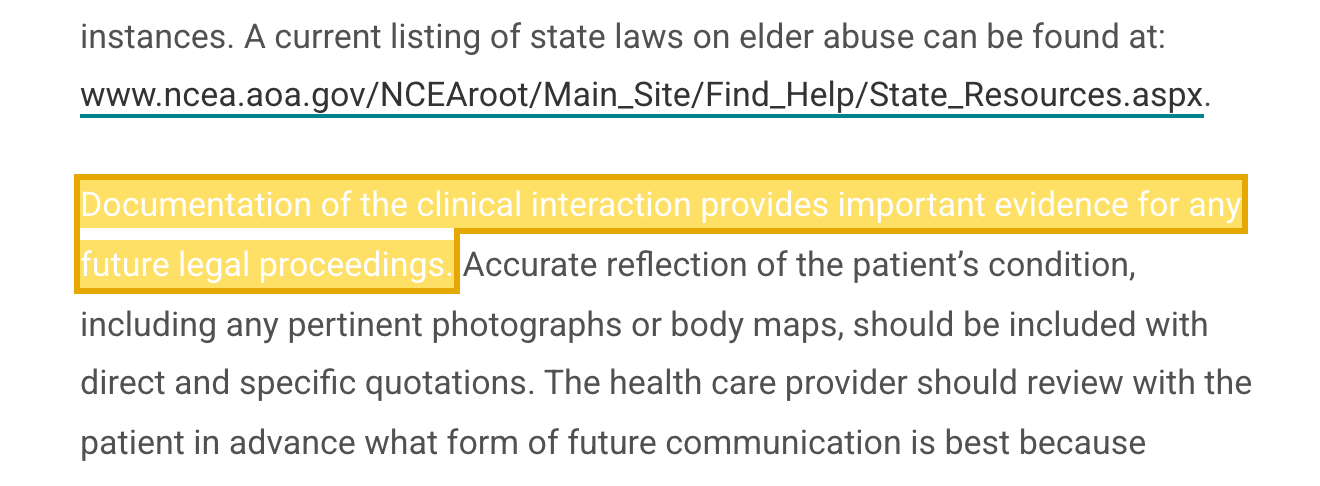
ACOG Committee Opinion 518: documentation — her words in direct quotation, photographs or body maps — is evidence for any future legal proceeding.
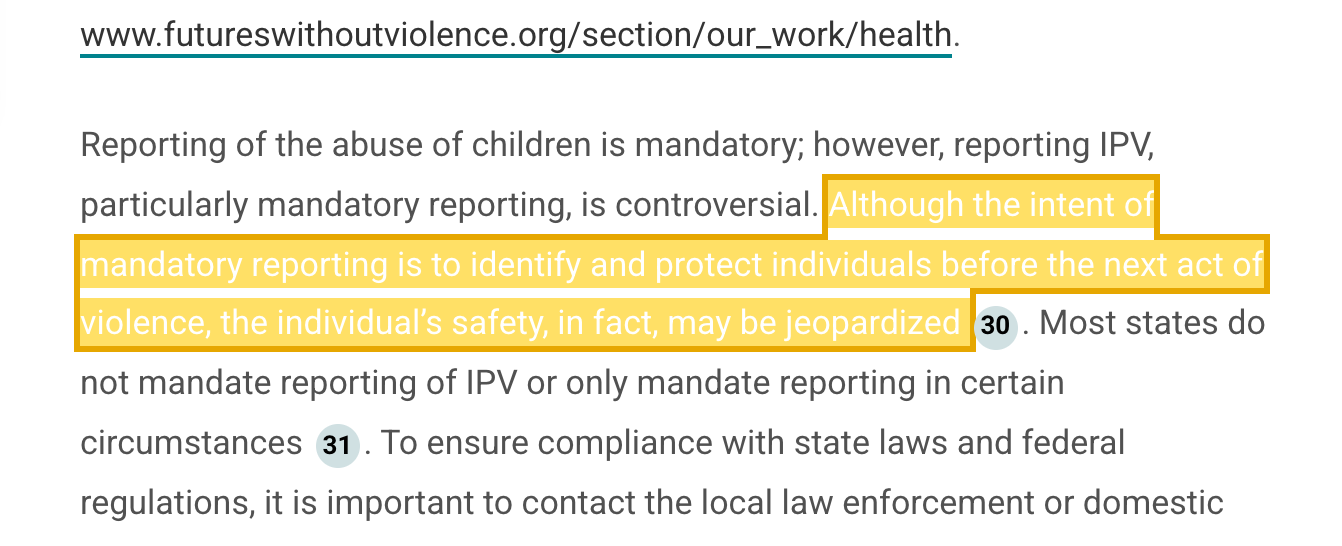
And know your own state's law before you are standing in that room. Mandatory reporting of intimate partner violence is genuinely contested, because reporting her without her consent can put her in more danger rather than less. Most states do not require it. Some do, in some circumstances. Find out which one you practise in before it matters.
What actually helps a woman in this situation is other women. The shelter is usually run by women. The advocate is almost always a woman. The friend who takes her in for the first three weeks is, more often than not, a woman. That network is the backstop the state is walking away from. The state walking away does not lower the work. It moves the whole weight of it onto the network. And the clinician's job in that network is the asking.
WHAT WOULD MOVE IT
One: write the relinquishment procedure. Not the prohibition — that exists, and Rahimi left it standing. The procedure. Who serves, who inventories, how many hours, which officer collects. Twenty-two states have done it. Twenty-eight have not.
Two: fund the scaffolding annually and stop letting the conditions on the money be rewritten between appropriations. Restore the tribal grants.
Three: fund civil legal aid, because ninety-two percent unmet is the number that turns an order into a piece of paper.
Four: in the exam room, tomorrow — ask. Every woman, every time, out loud, in plain language, with the partner out of the room. It is the cheapest intervention in all of medicine.
One lever tomorrow: if you are in one of the twenty-eight, the relinquishment step your state has never written.
CLINICAL SEGMENT
What mandatory reporting actually requires
Know your own state's law before you are standing in that room. This is the guidance the paragraph above is drawn from.
ACOG Committee Opinion 518: Although the intent of mandatory reporting is to identify and protect individuals before the next act of violence, the individual's safety, in fact, may be jeopardized. Most states do not mandate reporting.
FROM OUR FOUNDER, SERIALLY
The Gunman in the Room · 6 of 6
The asking is the work in an exam room. It is also, at scale, the argument this essay closes on: none of what medicine knows how to do activates on its own. Someone still has to be the one who acts.
What This Means for the Field, and Preventable Means Preventable
I want to be precise about something: this argument is not a critique of the companies building maternal health technology. It is a critique of the sequencing.
Imagine you are about to perform surgery, and there is someone with a weapon in the room. You can have the best hands in the world, the right tools, the right team, the right protocol. None of it activates until the gunman is gone. Blood pressure monitoring matters. Postpartum check-ins matter. But none of it will reach its potential until the power asymmetry is addressed directly.
The doula research is instructive here. A Cochrane meta-analysis of 27 randomized controlled trials found that continuous support during childbirth reduced cesarean rates by 25%, reduced negative birth experiences by 31%, and reduced low Apgar scores by 38%. A 2024 study in the American Journal of Public Health found that Medicaid-enrolled women with doula care showed a 47% lower risk of cesarean delivery — and Black and White doula recipients showed no significant differences in these outcomes. The racial disparity largely disappeared. Not because the medicine changed. Because the power dynamic in the room changed.
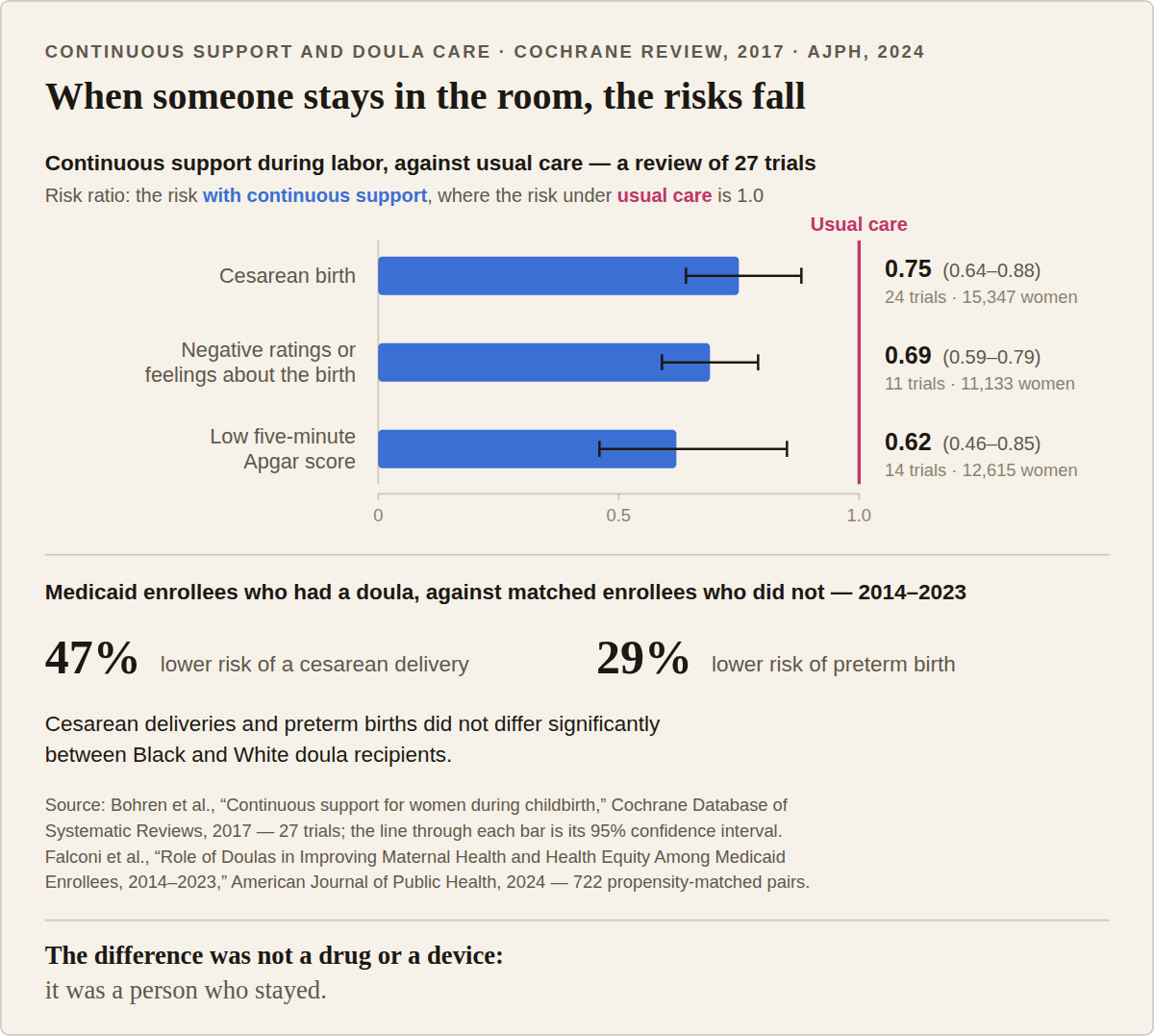
Women given continuous support during labor were less likely to have a cesarean birth (risk ratio 0.75, Cochrane review of 27 trials), and Medicaid enrollees who had a doula had a 47% lower risk of cesarean delivery.
The CDC finding deserves to be stated plainly. Eighty-four percent of the women who died did not have to die. The tools existed. The knowledge existed. What was missing, most often, was the power rebalancing in the room that would have forced the system to take this patient's urgency seriously.
The solution is not upstream and it is not technological. It is human, institutional, and immediate. It is the presence in the room that cannot be ignored.
The gunman has to come out first.
— Yamicia Connor, MD is the Founder and CEO of Diosa Ara, an emergency obstetrical infrastructure company whose mission is to eliminate preventable maternal death through the deployment of coordinated clinical and institutional power at the moment of obstetric crisis.
Read the whole essay in one sitting →
WHAT YOU ARE A PART OF · 13
This Isn't Idealism
If you are tired of waiting for this work to be done by someone else, you are not alone. Patients, providers, policymakers, parents — you deserve better than the version of healthcare you have inherited.
We can rewrite the rules. We can fund the research that matters. We can train clinicians to listen and to escalate. We can stop accepting maternal mortality numbers as a national identity.
This is not idealism. It is survival. It is the difference between a future in which women die because their symptoms were dismissed and their biology was misunderstood, and one in which they don't.
We've waited long enough.
— Dr. Yamicia Connor, Founder, Diosa Ara
THE ASK
The difference is who is standing there at three in the morning.
Most obstetric catastrophes are survivable if the right person recognises them early enough. That is not a technology problem. It is a staffing and escalation problem, and it is solvable. Diosa Ara is building the escalation layer, and your subscription is what pays for it.
UPCOMING
21 October · Diosa Ara Medicine Live: Labor & Delivery
22 October · Diosa Ara Medicine Live: Delivery Emergencies
WATCH THE LIVES
Every live from The Economic Body is on the series site, with the deck from each one that has aired.
The Economic Body — the lives, and the deck from each one →
To see the full schedule — the Collective calendar →
NEXT
That is the last hour of this week. The Economic Body stays up in full at its series site, and the work — the asking, the writing, the states still to write the step — continues in the Collective.
Thank you for being here. Forward this to one person who needs the spine.
— YC
Dr. Yamicia Connor, MD, PhD, MPH · Founder & CEO, Diosa Ara | Creator & Editor-in-Chief, The Labora Collective
A Labora Collective Publication — part of the Diosa Ara ecosystem