

The Briefing
THE LABORA COLLECTIVE · A DIOSA ARA INITIATIVE

THE ECONOMIC BODY / SEND 8
THE BRIEFING · October 13, 2026 · THE DEEP DIVE
SEND 8 OF 21
The comparator, and the money
What separates the United States is not prevalence but what is standing in the way, and the gun lobby has bought a party.
DR. YAMICIA CONNOR, MD, PHD, MPH

THE COMPARATOR
Step back to the world. In 2024, 83,000 women and girls were killed worldwide. Fifty thousand of them — sixty percent — were killed by an intimate partner or family member. About 137 women a day. One woman every ten minutes. For men who were killed, the same share is eleven percent.
The picture people carry is of walking home and a stranger appearing. That happens. You are far more likely to be killed by your loving, so-called loving partner.
But prevalence is not what separates the United States. About thirty-five percent of women worldwide have experienced intimate partner or sexual violence; here it is about thirty-seven percent. The same order of magnitude. The difference is what is standing in the way when it happens.
In Canada, revocation of a firearms licence is mandatory where the Chief Firearms Officer has reasonable grounds to suspect domestic violence or stalking. That has been in force since 4 April 2025. The companion provision — the one that would put a protection order on the same footing and give him twenty-four hours to hand the guns to a peace officer — is written into the Firearms Act and has still not been brought into force. In Victoria, Australia, a final family violence intervention order can cancel a firearms licence outright, and an officer attending a call can direct surrender on the spot. Refusing is an offence.
Victoria did not leave it to a legislature to get to eventually. Canada wrote the step and has not switched it on. Twenty-eight states have not written it at all.
THE MONEY
These statutes are the Peloton in the basement. You know you should get on it. You look at it every day, and you do not. Except that with your Peloton, nobody is paying you millions of dollars not to ride it.
In 2021, 172 members of the House voted to kill VAWA reauthorization. Every one of them was a Republican. Not most. All 172.
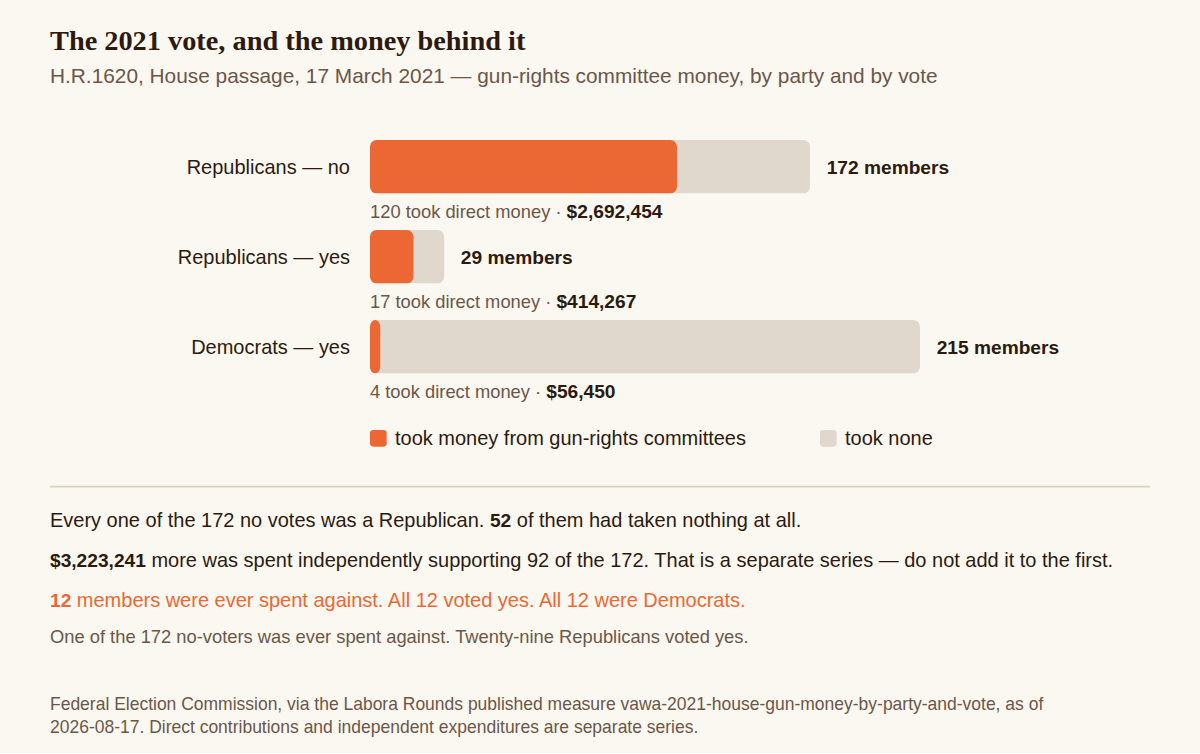
172 House Republicans voted to kill VAWA reauthorization in 2021. 120 of them had taken direct gun-lobby money.
Keep the two money flows apart, because they are different things. 120 of the 172 — almost seventy percent — took direct contributions from the gun lobby: $2.7 million. Separately, the lobby spent a further $3.2 million of its own money supporting 92 of them. That is spending on their behalf, not money they received.
Of the 215 Democrats who voted for the bill, four had taken direct gun lobby money. Four. And they voted for it anyway.
Then look at where the lobby spent money to fight. It spent to defeat twelve members who voted yes, all of them Democrats. The biggest target was Jared Golden of Maine, at about $64,000. It funds the no votes, and it attacks the yes votes.
The gun lobby does not have to buy a vote when it has bought a party.
For women it is the house.
Before the money, the picture: where a woman is actually most likely to be killed, compared across countries.
The international comparator behind tonight's opening section.


FROM OUR FOUNDER, SERIALLY
The Gunman in the Room · 4 of 6
The money in this hour bought silence in a vote. The essay below is about a cheaper decision, made just as quietly: a person with a hose, standing in front of a fire, who chooses not to use it.
The Firefighter
In a modern American medical system, an intraabdominal hemorrhage progressing over 12 hours to a patient's death should be impossible. Protocols exist. Tools exist. The intervention is known. And yet it happens. Women die of complications that medicine knows how to treat. They die with the solution available, down the hall, unused.
The CDC's Maternal Mortality Review Committees analyzed 1,018 pregnancy-related deaths across 36 states. Eighty-four percent were judged preventable. This is not a knowledge gap. Medicine knows what kills women in childbirth and how to stop it. The E-MOTIVE trial, published in the New England Journal of Medicine in 2023, enrolled 210,132 women across 80 hospitals and demonstrated that a standardized early-detection-and-treatment bundle for postpartum hemorrhage reduced severe hemorrhage outcomes by 60%. Detection rates in intervention hospitals rose from 51% to 93%. Treatment adherence rose from 19% to 91%. The intervention worked because it made the protocol unavoidable — it removed the human judgment about whether this patient's hemorrhage was urgent enough to act on immediately.
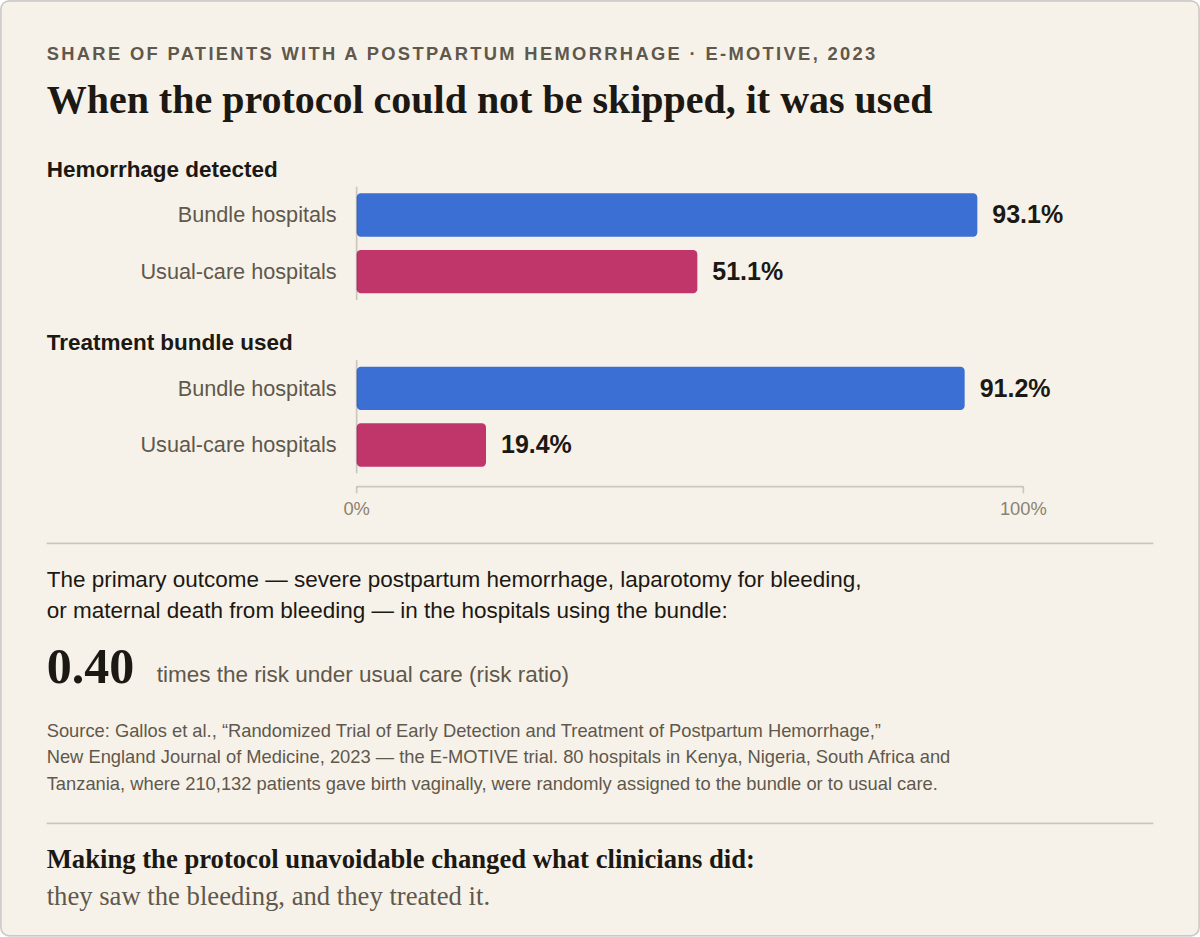
In the E-MOTIVE trial, hospitals using the bundle detected postpartum hemorrhage in 93.1% of patients, against 51.1% in hospitals giving usual care, and used the treatment bundle in 91.2%, against 19.4%.
Think about a firefighter standing in front of a burning house. He has a hose. He has training. He knows exactly what to do. And he refuses to use the hose. He stands there and watches the house burn.
That is what sending a woman home with the worst headache of her life looks like. The brain scan exists. The neurologist is down the hall. The protocol is unambiguous. And she went home. Not because medicine failed. Because a human being inside a system with every resource available made a calculation — conscious or not — that her urgency was negotiable.
A 2025 analysis interviewed 56 women of color who survived maternal near-misses in the United States. The Third Delay — failure to receive adequate care once at the facility — was the dominant theme. These women reached the hospital on time. The hospital did not meet them there.
Read the whole essay in one sitting →
WHAT YOU ARE A PART OF · 9
We Still Don't Understand the Basics
The medical field does not understand how a woman's body works. That isn't rhetoric.
We don't know what triggers labor. We can't reliably diagnose endometriosis, even though it affects roughly one in ten women — and the average delay from first symptom to diagnosis is years long. Most of our disease models are built on male biology, because until 2016 even animal studies routinely excluded female subjects on the grounds that estrous cycles were too noisy to bother with. Our understanding of how hormones and the immune system interact — the systems that shape everything from autoimmune disease to perinatal mood disorders — is rudimentary.
Meanwhile, the conditions that disproportionately affect women — autoimmune disease, chronic pain syndromes, PCOS, perinatal depression, postpartum hemorrhage, severe maternal morbidity — are routinely misdiagnosed, under-researched, or dismissed.
This is not a knowledge gap. A gap implies the work is in progress. This is a structural choice — which questions get asked, which patients get studied, which deaths get audited. The choice has been made, decade after decade, against women.
THE ASK
More than a third of American counties.
More than a third of American counties have no hospital that delivers babies. The law still requires a hospital that closed its labor unit to handle a woman who arrives in labor, with no one there who can. That is the gap Diosa Ara was built to stand in. Your subscription pays for it.
UPCOMING
12 October · Yemaya's Legacy — Your Health History (Live)
12 October · Nausea and Vomiting of Pregnancy & Hyperemesis Gravidarum
WATCH THE LIVES
Every live from The Economic Body is on the series site, with the deck from each one that has aired.
The Economic Body — the lives, and the deck from each one →
To see the full schedule — the Collective calendar →
NEXT
The obvious question is why she does not defend herself. This whole hour is the answer.
Thank you for being here. Forward this to one person who needs the spine.
— YC
Dr. Yamicia Connor, MD, PhD, MPH · Founder & CEO, Diosa Ara | Creator & Editor-in-Chief, The Labora Collective
A Labora Collective Publication — part of the Diosa Ara ecosystem