

Viva Voce
THE LABORA COLLECTIVE · A DIOSA ARA INITIATIVE

THE ECONOMIC BODY / SEND 9
VIVA VOCE · October 16, 2026 · READ-ALOUD FROM THE LABORA COLLECTIVE
SEND 9 OF 21
The other door
Keshia Golden was eight months pregnant when she stabbed her boyfriend to make him stop; Cook County charged her with first-degree murder.
DR. YAMICIA CONNOR, MD, PHD, MPH

THE OTHER DOOR
The obvious question is why she does not defend herself. This whole hour is the answer. There are very few laws protecting her, and even when one passes, the gun usually stays in the house because no one wrote the step that removes it. So she is left holding whatever tool she has.
This is what the state does with her instead.
More than 80 percent of incarcerated women have histories of abuse.
Keshia Golden was eight months pregnant. In October 2022, here in Chicago, her boyfriend, Calvin Sidney, attacked her, and she stabbed him with a knife to make him stop. The blade hit his femoral artery. He died at the hospital. She was arrested that night and treated for her own injuries.
This was not the first time. He had been arrested four times for hurting her. She had been arrested once for hurting him. No charges were filed in any of those incidents — not one. While she was in her second trimester, she got an order of protection against him after he punched her in the face, and later dismissed it; her attorneys say she was under duress when she did. She left him more than once.
Cook County charged her with first-degree murder.
She waited four years. Her trial was set to begin on a Monday in August 2026. That morning, she pleaded guilty to involuntary manslaughter and took twenty-four months of probation. Her public defender, Julie Koehler, said this: "She is not guilty of these charges. But there isn't a woman or mother alive that, when faced with spending 20 to 60 years in prison, wouldn't take a plea to probation."
She had turned down an earlier deal — second-degree murder, time served — because a violent-offender conviction would have followed her through every housing application and every job for the rest of her life. The deal she took spared her that. She has a three-year-old daughter now, the baby she was carrying that night. She said: "All she got is me."
And Marissa Alexander fired a warning shot at her abusive husband in Florida. She injured no one. She was sentenced to twenty years.
The scale is horrifying. 26,326 women were in prison in 1980. In 2023, it was 186,244 — seven times as many, growing at twice the rate for men. The number of women serving sentences of a year or more grew 757 percent between 1977 and 2004. More than a million women are now under some form of correctional supervision.

26,326 women in prison in 1980. 186,244 in 2023 — seven times as many.
Black women are 4.5 times more likely to be incarcerated than white women; American Indian and Alaska Native women, 4.3 times. 62 percent of women in state prison have a child under 18. Some 2.7 million children have a parent inside.
And on the other side of the same courthouse: in Chicago, sex crimes with a white victim ended in conviction 40.6 percent of the time. With a Black victim, 25.5 percent. When she is the one reporting, the case is likelier to go nowhere.
It is the same fact pattern. The same man, the same house, the same gun. One door leads to a relinquishment order that twenty-eight states have never written. The other leads to a prison sentence. Which door opens is decided, right now, by whether her state wrote the step.
A SERIES, SERIALLY
They Called It Suicide · 5 · The Missing
One door tonight leads to prison for defending herself. The other, the one this series has followed for five weeks, is a death a category simply declines to count. Both are the same mechanism: a system deciding, on paper, that a life does not have to be reckoned with.
A federal hate crime is built on an underlying crime — a homicide, an assault. A death ruled suicide is, by definition, not a homicide, so the moment the manner is written, the death becomes ineligible to be counted as a bias crime. Not unlikely. Ineligible. The category closes before anyone asks the question.

A death ruled suicide leaves every count that would catch it.
And the count behind it is voluntary. In a given year, roughly 80 percent of law-enforcement agencies report zero hate crimes to the FBI — not few, zero. Four states have no hate-crime statute of any kind, so there is no weak count to criticize there; there is nothing to count against.
Lennon Lacy was seventeen, found hanging from a swing set in Bladenboro, North Carolina, in 2014. Ruled suicide; the FBI reviewed it in 2016 and found no evidence of homicide. His family says the dog leash and belt were not his, the sneakers were a size and a half too small, and the crossbeam was seven and a half feet up with nothing beneath it to stand on. Every element they dispute is physical.
To'nea Nicole Miller was twenty-seven, found near a park in Miami in 2026. Ruled consistent with suicide. Florida law seals a suicide-ruled autopsy from the public — so the one document that might settle it inside her own divided family is the one nobody in it is allowed to read.
You cannot fund a response to a problem that reads as zero. The absence of data becomes the absence of a problem, and the families carrying the real thing are told the statistics do not show what they live.
The whole argument, in one piece →
WATCH
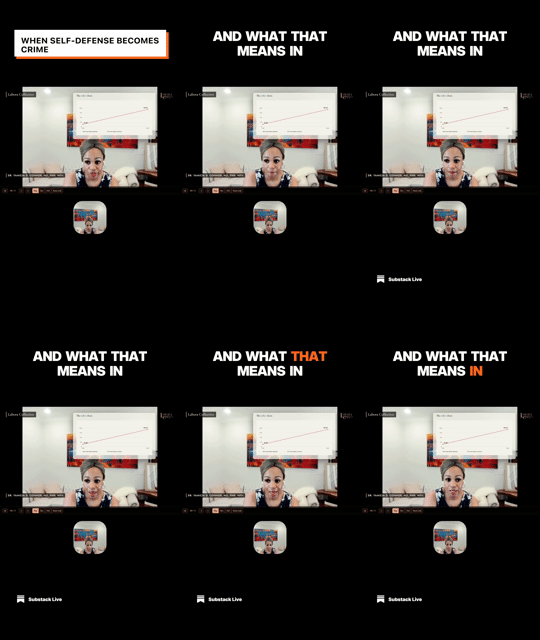
When Self-Defense Becomes Crime
Keshia Golden and Marissa Alexander are not exceptions. This clip is the pattern they sit inside.
Weapon access is the single biggest factor in whether this becomes fatal.
WHAT YOU ARE A PART OF · 10
The System Was Not Built for Us
Women were excluded from most clinical trials until the 1990s. The justification was always biological complexity — the menstrual cycle, the possibility of pregnancy, the inconvenience of variability. The result is that we still extrapolate dosing, side-effect profiles, and disease progression from male bodies, then act surprised when women have worse outcomes on drugs that were never validated in them.
The exclusion isn't symmetric. Black women in the United States are three to four times more likely to die from pregnancy-related causes than white women. That gap doesn't close when you control for income. It doesn't close when you control for education. The gap is racism — the everyday clinical version, embedded in who gets believed, who gets imaged, who gets escalated.
We have built a healthcare system on top of centuries of erasure. We are living with the consequences and asking why outcomes are bad.
THE ASK
This is not a donation.
Your subscription is not charity and it is not a tip. It buys clinician time, it buys the database, and it buys the infrastructure that puts an obstetrician where there is not one. You are not supporting a publication. You are funding an emergency medical model that publishes what it finds.
UPCOMING
19 October · Yemaya's Legacy — STIs & Infections (Live)
19 October · Recurrent Pregnancy Loss — Workup
WATCH THE LIVES
Every live from The Economic Body is on the series site, with the deck from each one that has aired.
The Economic Body — the lives, and the deck from each one →
To see the full schedule — the Collective calendar →
NEXT
The complaint on the schedule was right-flank pain. The visit was supposed to take fifteen minutes. She talked for thirty-five.
Thank you for being here. Forward this to one person who needs the spine.
— YC
Dr. Yamicia Connor, MD, PhD, MPH · Founder & CEO, Diosa Ara | Creator & Editor-in-Chief, The Labora Collective
A Labora Collective Publication — part of the Diosa Ara ecosystem