

The Briefing
THE LABORA COLLECTIVE · A DIOSA ARA INITIATIVE

THE ECONOMIC BODY / SEND 11
THE BRIEFING · October 22, 2026 · THE DEEP DIVE
SEND 11 OF 21
The structure I gave her
The hospital is a safe place, and she can be admitted for roughly forty-eight hours without having to explain herself to anybody.
DR. YAMICIA CONNOR, MD, PHD, MPH
THE STRUCTURE I GAVE HER
Tell the trusted people — not everyone, only the ones she had already judged safe. Stage the documents at one of their houses, not at home: identification, birth certificates, bank information, immigration paperwork, whatever cash she could gather. And do not telegraph the leaving in advance — that is not instinct; that is what the femicide-risk research and the women who have done this longer than I have both say. The moment a departure is announced is the moment of greatest danger.
Two nonprofits I have worked with and know to be real and discreet. A text sent from the room. A short printed list, nothing branded in a way that gives itself away at a glance, with the twenty-four-hour numbers marked. And none of it written into a note she might have to open on a shared portal he can see.
And then the thing I tell every woman, which almost nobody knows.
Start with what the standard of care actually says. The clinical reference every one of us is trained on says it in one line: do not discharge the patient until a safe haven has been established. That is the instruction. Do not send her home until she has somewhere safe to go.
Now follow that where it leads. If the shelter is full, and the hotline is on hold, and there is no bed within a hundred miles — and that is most nights — then she has nowhere safe to go, and I am not permitted to discharge her. So where is she? She is in the hospital. She stays. Whatever anyone writes in the chart, what she practically is, is admitted.
So the hospital is a safe place. We always have a safe bed.
That is not a figure of speech. It is a real thing with a name, and she can come here at any time and be admitted for roughly forty-eight hours without having to explain herself to anybody. She does not need an obstetric reason. She does not need to be in labour. She does not need to have been hit that day. If what she needs is a door that locks and a bed he cannot reach, this is one, and it is open at three in the morning.
I have practised in two states, Massachusetts and North Carolina, and it has been available in both. I do not know of a state where it is not, and I would genuinely like to know if there is one.
Forty-eight hours is not a solution. It is nowhere near enough. It is not housing. But it is something real that we can give a woman tonight, in a system that has almost nothing else to give her, and most women have no idea it exists.
Three other things I say, because they are the ones that actually change the odds.
Weapon access is the single biggest factor in whether this becomes fatal. Not how angry he is. Not how many times it has happened. Whether he can get to a gun.
Get the documents in order, and get them out of that house. This is the part people underestimate. Some things cannot be replaced quickly, or at all, and most of them are the children's. Birth certificates. Passports, hers and theirs. Social Security cards. Deeds. Immigration paperwork. Whatever money she can put aside. All of it staged in the home of somebody she trusts, outside his control, so that leaving the area at short notice is actually possible — because leaving the house is not always far enough.
And I say this to women plainly, because it is the thing that determines whether it works. Leaving is not something you decide on a whim. It is something you prepare for, often over months. If she wants to maximise the chance that she and her children come out of this unhurt, the preparation is the plan. The day she goes is the last step, not the first.
Another adult in the household is protective. If there is a father, a sister, a friend who can be there tonight, that is not a small thing. That is a real intervention, and I say so out loud so she does not treat it as a favour she is imposing on somebody.
And none of that is my invention. There is a study I keep going back to — Campbell and colleagues, eleven cities, two hundred and twenty women killed by an intimate partner, compared with three hundred and forty-three abused women who were not killed. Published in the American Journal of Public Health.
What raised a woman's risk of being killed: his access to a gun. A previous threat with a weapon. His stepchild living in the home. And estrangement — separation — especially from a controlling partner. At the incident itself: her having left for another partner, and his use of a gun. Stalking, forced sex, and abuse during pregnancy showed up too.
What lowered it: never having lived together, and a prior domestic violence arrest.
I want to be careful with the separation finding, because it gets repeated loosely. The study measures risk after separation. It does not measure the specific moment a woman announces she is leaving. What I tell women about not telegraphing the departure comes from the advocates as much as from the paper, and I say it that way.
And look at what that list actually is. Access to a gun. A previous threat with a weapon. His use of a gun at the incident. Three of the strongest predictors are the gun — the object twenty-eight states never wrote the step to take out of the house. The study says the rest plainly: one of the major ways to decrease intimate partner homicide is to identify and intervene with battered women at risk. We have known who is at risk since 2003. We wrote it down.
One finding sits badly, and I am going to say it anyway. A prior domestic violence arrest lowered a woman's risk. But an arrest only counts if something follows it. Calvin Sidney was arrested four times for hurting Keshia Golden, as we heard, and no charges were ever filed. An arrest that goes nowhere is not the thing that the study measured.
And this is not only my reading of one paper. There is a professional consensus about what to do in that room, and it did not come from doctors. It came from domestic violence advocates — the people who do this every day — through Futures Without Violence, and it is written into ACOG's own committee opinion on intimate partner violence, which ACOG reaffirmed in 2025.
Here is what they say to do.
Acknowledge it out loud. Assess whether she and her children are safe right now, tonight. Then help her build a safety plan — build it with her, not hand her one.
The risk factors they tell clinicians to ask about are the same list the research found: previous acts of violence, estrangement from the partner, threats to her life, threats with a weapon, a previous nonfatal strangulation, and his access to a gun.
Offer her the resources — crisis lines, shelters, legal aid, mental health services — and make a real referral, not a gesture. The guidance says a local domestic violence agency is usually the best resource, and the national hotline is multilingual and will connect her to programs where she actually lives.
And here is the single most practical thing in the whole document, which I want every clinician listening to write down. Offer her a private phone, in your office, to make the call from. Controlling partners monitor cell phone logs and internet history. A woman can walk out of your office with the right number in her hand and never be able to dial it safely.
Two things they tell you not to do.
Do not try to force her to accept help. It is her call. It has to be, and if you take that from her, you have done the same thing he does.
And do not slip literature into her purse or bag for her to find later. That sounds kind. The guidance is explicit that it is dangerous, because he may find it first, and then the violence escalates. Give it to her openly or do not give it at all.
One more, and it is the one we forget. Before she leaves, ask her how it is safe to contact her. A bill in the mail. A follow-up call from the front desk. A result posted to a portal he can open. Any one of those can be the thing that sets him off. Work it out with her while she is still in the room.
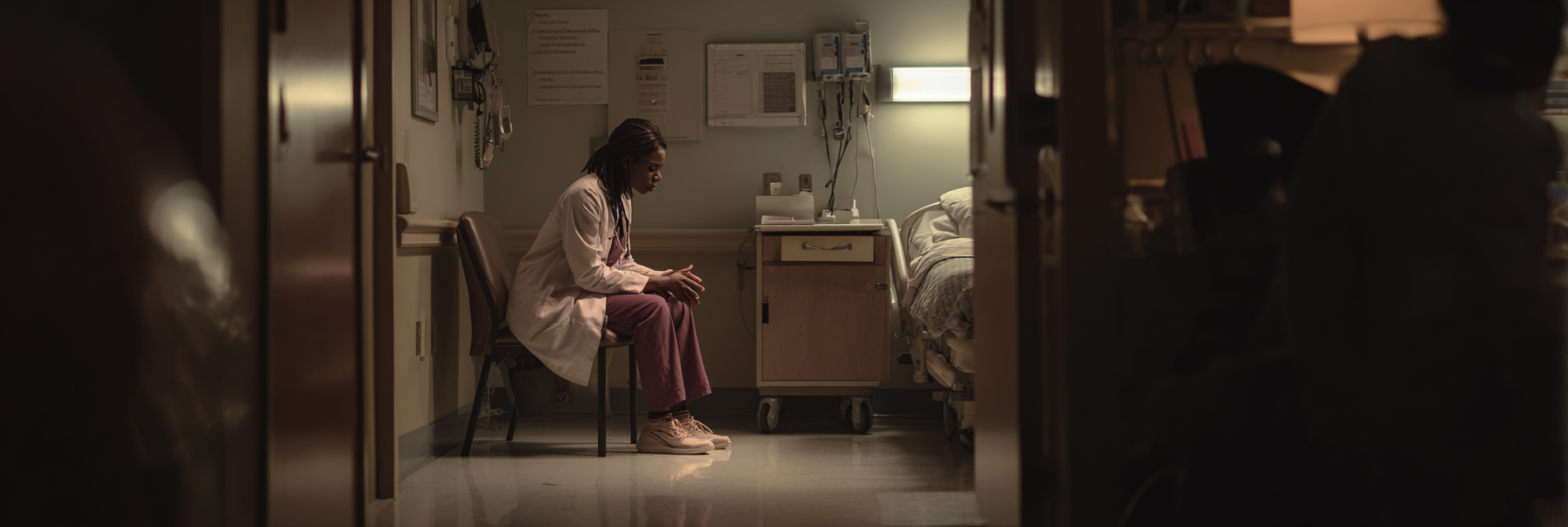
Then I did the urinary-tract work. I wrote the antibiotic. I scheduled the follow-up culture.
AND THEN I SENT HER BACK INTO IT
This is the hardest thing this work asks of you.
The safe bed was there, and I offered it, but forty-eight hours does not fix a housing problem. No shelter within a reasonable distance had a bed either. I had no legal-aid lawyer to put on the phone at four in the afternoon, and no statute that was going to make the guns leave that house tonight.
What I had been able to give her was an antibiotic, a follow-up, a small printed list, a text already sent — and thirty-five minutes in which the thing had, for the first time in months in her telling, been named out loud by someone who was not going to use the naming against her.
On her way out, she told me that no one had ever asked her this before. I told her she should not have had to wait this long for the question.
A SERIES, SERIALLY
They Called It Suicide · 6 · Naming Them (Finale)
Everything in this hour is a structure built because the state's own structure was not there. The series closes the same way — not with a solution, but with names, because naming what the record would rather lose is itself the work.
Confidence in the police: about 56 percent among Black Americans, against roughly 74 percent among white Americans. Expectation of fair treatment from the system: about 61 percent against roughly 90. Nine in ten against six in ten — a wariness that six weeks of this series have traced as a pattern, not a mood, and the polling puts a number on the gap.

Nine in ten against six in ten.
The CDC runs a violent-death reporting system detailed enough to show how often a manner-of-death ruling is disputed, and by race. It exists. It is restricted. It is not public. The one figure that would move this from pattern to measurement is the one nobody outside can see.
Demartravion "Trey" Reed was twenty-one, found at Delta State University in Cleveland, Mississippi, this September. Ruled hanging, suicide, by the state medical examiner; the county coroner and city police found no lacerations, contusions, or fractures. His people say the belt was three times his size and the buckle was missing. A second autopsy, funded independently, has not been released. The FBI and a member of Congress have both asked for a federal review. It is open.
Ninety-eight people. One undetermined. Two who were shown the file and found their answer in it. More than half still being verified, and the number is not done growing. The families are not asking for a new system. They are asking the country to notice which one is still running, and to say the names out loud while it does.
The whole argument, in one piece →
What raised it. What lowered it.
The risk factors in this hour are not a clinician's impression. Here is the study they come from, laid out.
The Campbell study risk factors named in this hour, in one chart.


WHAT YOU ARE A PART OF · 12
Why I Built Diosa Ara
I founded Diosa Ara to do the work the system has refused to do. Not as a company alone — as a model.
A model that centers clinical excellence, scientific integrity, and equity, in that order, and does not treat them as competing values. A model that sees women in their full complexity — biological, emotional, political, economic — and refuses to peel those apart for the convenience of a billing code. A model that does not pretend fertility is separable from family structure, or health from structural inequity, or maternal mortality from race.
We are building care, consulting, content, and community in a single ecosystem, driven by women and designed to challenge the systems that have failed women for too long. We are not interested in describing what is broken. The description is finished. We are building what comes next.
THE ASK
Built without asking anyone's permission.
No federal grant, and no investor who needed the market to be bigger before it was worth fixing. The Labora Collective is funded by the people who read it, which is the only reason it can say what it says. Membership is the whole model.
UPCOMING
21 October · Diosa Ara Medicine Live: Labor & Delivery
22 October · Diosa Ara Medicine Live: Delivery Emergencies
WATCH THE LIVES
Every live from The Economic Body is on the series site, with the deck from each one that has aired.
The Economic Body — the lives, and the deck from each one →
To see the full schedule — the Collective calendar →
NEXT
Asking is a learned skill, like any other in medicine. There is no excuse in 2026 for a clinician who cares for women not to have built it.
Thank you for being here. Forward this to one person who needs the spine.
— YC
Dr. Yamicia Connor, MD, PhD, MPH · Founder & CEO, Diosa Ara | Creator & Editor-in-Chief, The Labora Collective
A Labora Collective Publication — part of the Diosa Ara ecosystem