

The Signal
THE LABORA COLLECTIVE · A DIOSA ARA INITIATIVE

THE ECONOMIC BODY / SEND 4
THE SIGNAL · {{current_date_full}} · WEEKLY CLINICAL INTELLIGENCE
SEND 4 OF 21
The trap with no exit
Rent has priced escape out of reach, and the legal aid and shelter beds built to close that gap are being pulled away at the same time.
DR. YAMICIA CONNOR, MD, PHD, MPH

The economy is not the backdrop to this violence. It is the lever on it. And in 2025 and 2026 that lever is being pulled hard, in the worst direction, from two sides at once.
SIDE ONE — SHE CANNOT RENT A PLACE TO BE SAFE IN
When a one-bedroom apartment costs more than a full-time minimum-wage paycheck, the math of escape simply does not work.
SIDE TWO — THE SCAFFOLDING BEING PULLED
The public infrastructure built precisely to close that gap is being dismantled.
Civil legal aid — the thing that turns a restraining order into protection — was already failing: ninety-two percent of the civil legal problems of low-income Americans get no adequate legal help at all.
The shelters, the places of last resort: on a single day in September 2024, domestic violence programs could not meet more than fourteen thousand requests for help. Most were for a safe place to sleep. Many came from women with children.
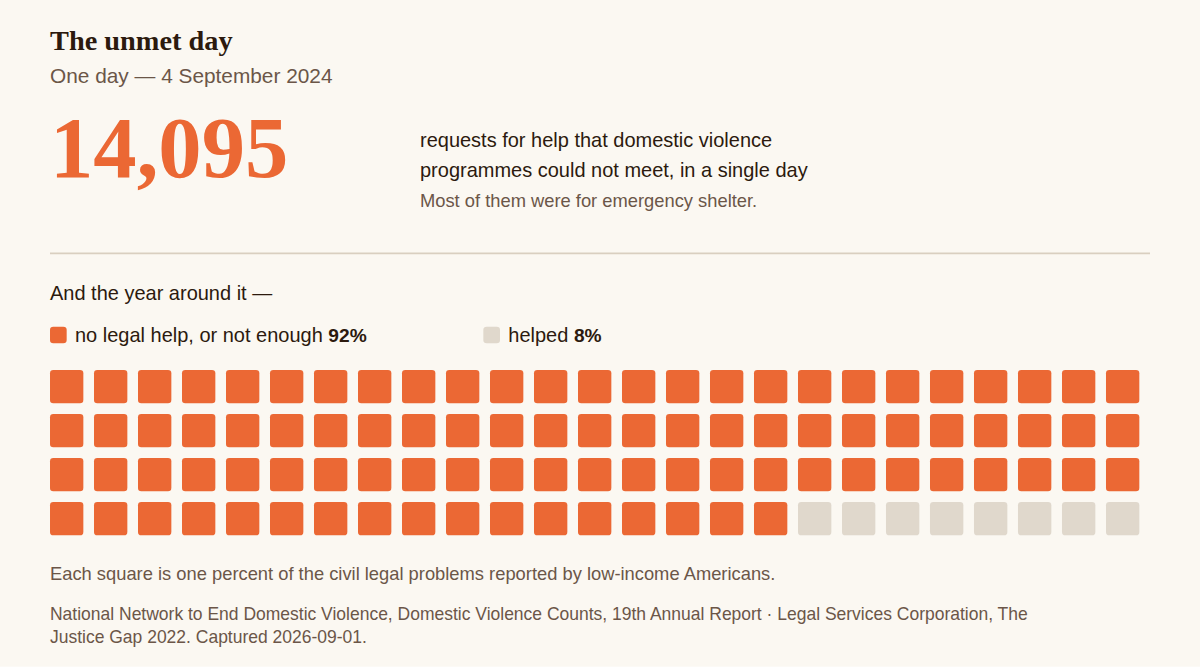
On a single day in September 2024, domestic violence programs could not meet more than fourteen thousand requests for help.
Sit with that at the level of one woman. She finally found the courage to make the call. Making it, she risked detection. And she is told there is no bed within a hundred miles. Imagine how disillusioning that is. Imagine how much risk we just put her in. She is sent straight back to the most dangerous place she knows.
THE TRAP WITH NO EXIT
Abusers understand this leverage better than anyone in the story. They use her reproductive health directly — hiding the pills, sabotaging the birth control, forcing a pregnancy that ties her to him permanently. In states where abortion is now banned, that is a trap with no exit.
Worse than no exit: if she miscarries and he decides the circumstances look suspicious, he can hand that story to the state and let the state carry out the retribution.
PREGNANCY IS NOT A REPRIEVE
Roughly one in eight abused women report the abuse began during pregnancy, and for many it escalates as the pregnancy advances and the abuser feels the household's attention shift toward a child.
That is when the blows begin. And when they come, they are aimed at the abdomen.
That cruelty is not random. It is her anatomy, weaponized. It is why intimate partner violence is an independent risk factor for placental abruption — the placenta sheared off the uterine wall, the hemorrhage, the fetus starved of oxygen in minutes, a mother who can die of it. And even with no blows at all, sustained terror does its own damage: chronic maternal stress is tied to preterm birth.
So when a budget line for domestic violence funding is cut, I do not read it as a budgetary decision. I read it as a forecast of what is going to arrive in our hospitals.
WATCH
Economy Fuels Domestic Violence
The shelter bed that is not there and the rent she cannot make on her own are the same fact, said twice. This clip says it in ninety seconds.
The economy is not the backdrop to this violence.

FROM OUR FOUNDER, SERIALLY
The Gunman in the Room · 2 of 6
Every trap in this hour is made of money: no income, no exit. The essay below names a harder version of the same claim — that even where the income is there, in full, something else decides who the system protects, and it isn't the balance in her account.
What the Data Actually Says
Black women in the United States die in childbirth at 3.2 times the rate of White women. That statistic is widely cited. What is less widely discussed is what it does and does not tell us.
The instinct is to reach for explanations that feel solvable: insurance coverage, access to care, prenatal visits, geography, poverty. These are real factors. They matter at the margins. But here is the data point that forecloses every one of those explanations.
A 2023 study in The Lancet Regional Health analyzed 13 million live births and found that Black mothers in the least vulnerable counties — the counties with the best access, the best resources, the most support — remained at higher risk of maternal mortality than White mothers in the most vulnerable counties. The racial gap was not explained by county-level resources. It persisted regardless of where the woman lived.
The CDC's own data is equally direct. Among college-educated Black women, the pregnancy-related mortality ratio is 5.2 times that of college-educated White women — and 1.6 times that of White women without a high school diploma. More education makes White women safer. It does not make Black women safe. A 2022 NBER study linking birth records to IRS income data found that maternal mortality rates among the highest-income Black women equaled those of low-income White women.
Serena Williams. Beyoncé. Both described having to fight for their lives in medical settings despite every credential, every resource, every advocate money could provide. This is not anecdote. It is confirmation of what the data already shows: wealth cannot buy out of this disparity. Education cannot either.
When socioeconomic status, education, institutional access, and personal wealth all fail to explain a disparity, you have isolated the variable. That variable is structural racism — not personal prejudice, but a systemic orientation of the medical institution toward some bodies and away from others.

Read the whole essay in one sitting →
WHAT YOU ARE A PART OF · 4
The Specific Failures
We do not train doctors to listen to women. We do not reimburse the time complex care requires — and women's care is complex care. We do not fund the research that would let us answer first-order questions about female physiology. When we talk about innovation in health technology and biotech, the questions we forget to ask are the political ones: Who is this for? Who gets access? Who is the trial designed around? Who gets left behind?
THE ASK
The most expensive place in the world to have a baby, and the most dangerous.
The Labora Collective is the community around Diosa Ara's medical model. Diosa Ara is an obstetrical emergency company. It exists because of one fact that should not be possible: the United States is the most expensive country in the world to have a baby, and among comparable countries it is the most dangerous. Those two things cannot be true of a working system at the same time. That they are true here points to something structural, and Diosa Ara is building the infrastructure to change it. When you join the Collective, your subscription is what funds that work.
UPCOMING
25 September · Architecture of Harm · Live · Ep. 6 · Chapter 3 · Funding and the Safety Net — The Money
2 October · Architecture of Harm · Live · Ep. 7 · Chapter 4 · Disease Acceleration
WATCH THE LIVES
Every live from The Economic Body is on the series site, with the deck from each one that has aired.
The Economic Body — the lives, and the deck from each one →
To see the full schedule — the Collective calendar →
NEXT
Most people have heard of VAWA. The details are rarely discussed — including the sentence it never wrote: the one that sends anyone to go get the gun.
Thank you for being here. Forward this to one person who needs the spine.
— YC
Dr. Yamicia Connor, MD, PhD, MPH · Founder & CEO, Diosa Ara | Creator & Editor-in-Chief, The Labora Collective
A Labora Collective Publication — part of the Diosa Ara ecosystem