

The Signal
THE LABORA COLLECTIVE · A DIOSA ARA INITIATIVE

THE ECONOMIC BODY / SEND 7
THE SIGNAL · October 12, 2026 · WEEKLY CLINICAL INTELLIGENCE
SEND 7 OF 21
Twenty-two states wrote it down. Twenty-eight never did.
Under Karina's Law he has twenty-four hours to surrender every firearm, and if he does not, they come with a warrant.
DR. YAMICIA CONNOR, MD, PHD, MPH

WHAT THE GAP COSTS
Firearms are used in two-thirds of intimate partner homicides of women. For pregnant women, 69.2 percent. There are more than a thousand intimate partner homicides of women in a year.
And the escalation is legible in advance, which is what makes this a failure rather than a misfortune. A woman who has been strangled once carries seven and a half times the homicide risk. All fifty states have made strangulation a felony. The elements differ from state to state, but there is no state where it is not one — so the system can already see her. She is in a charge, in a record, in a file. The order gets written. The gun stays.
THE LEVER IS THE STATES
The states are where this actually lives. Twenty-two states now require an abuser under a restraining order to hand over his guns. Twenty-eight do not.
It is like the book you meant to write, and started, and never finished. Except this is not a book. This is life-saving legislation that state governments began and left where it lay. Twenty-two states wrote it down. Twenty-eight never did.
KARINA'S LAW
And here is what it takes to get one of those twenty-two states to write the step down.
Her son Manny Alvarez was eighteen when he was shot in his own dining room and lost his mother and his sister in the same minute. He spent the next year and a half testifying, lobbying, standing at press conferences. House Bill 4144 became Karina's Law by amendment on 6 January 2025 — a year and a half after they were killed.
It passed the Illinois Senate forty-three to ten and the House eighty to thirty-three. Governor Pritzker signed it on 10 February 2025. Manny Alvarez was twenty years old and standing behind him. It took effect on 11 May 2025.
What it actually does is the whole argument of tonight, written into statute. Before it, Illinois law said the abuser's firearms should be turned over to someone with a valid card for safekeeping, and left it unclear who was responsible for making that happen. Karina's Law names the responsibility and puts a clock on it. When the order of protection is served, the respondent has twenty-four hours to surrender every firearm, every firearm part, and his FOID card. And the petitioner or the state's attorney can ask the court for a search warrant for those weapons, which law enforcement must execute within ninety-six hours — four days — and file a return within twenty-four hours after that.
Twenty-four hours. Not a form he fills out himself when he gets around to it. Twenty-four hours, and if he does not, they come with a warrant.
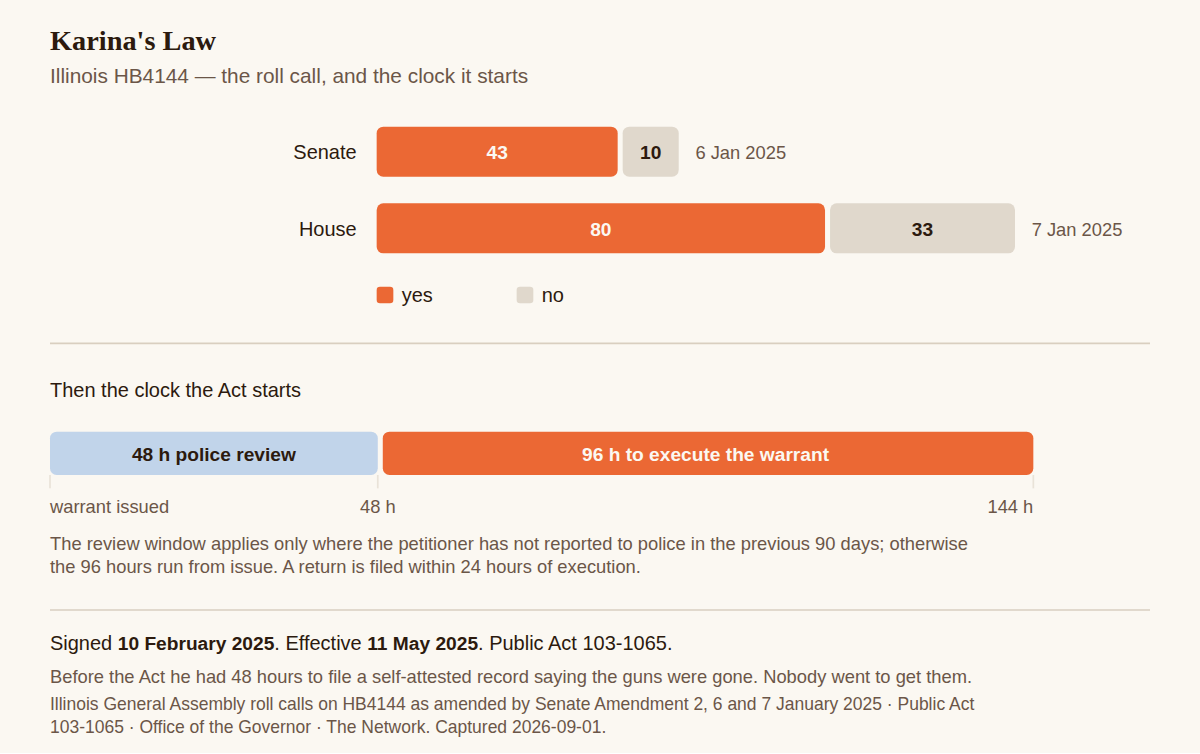
Twenty-four hours to surrender every firearm, or the state comes with a warrant.
That is the difference between a prohibition and a procedure, and it is four paragraphs long.
Amanda Pyron, who runs The Network, the Illinois domestic violence coalition, said the thing I want you to hear: an emergency order of protection is often the first step out of a violent relationship, and it can also be the most dangerous. Illinois saw a sixty-three percent increase in gun-related domestic violence deaths between 2019 and 2023.
Representative Maura Hirschauer, who carried the bill, said at the signing: here in Illinois, we value your life and the life of your family more than we value your abuser's gun.
And say the last part plainly. Jose Alvarez died in June 2026, before he was ever tried. Manny Alvarez got a law. He did not get a verdict.
WHAT THE COURTS DID TO IT
Two decisions sit over all of this.
Bruen was decided 23 June 2022 and replaced the test for gun regulation with text, history, and tradition — which meant every relinquishment statute in the country suddenly had to be defended against eighteenth-century thinking. Rahimi was decided on 21 June 2024 and left the federal domestic violence prohibition standing.
So the constitutional question is answered, and the procedural one is not. Twenty-eight states could write the step tomorrow, and nothing in the Constitution would stand in the way.
THE TWENTY-TWO
California, Colorado, Connecticut, Hawaii, Illinois, Iowa, Louisiana, Maryland, Massachusetts, Minnesota, New Hampshire, New Jersey, New Mexico, New York, North Carolina, Oregon, Pennsylvania, Rhode Island, Tennessee, Virginia, Washington, Wisconsin.
This is not a red-and-blue story and should not be told as one. Louisiana is on that list. So are Iowa, Tennessee, and North Carolina. Whatever else those states disagree about, they wrote the step that takes the gun.
So the finding is not that states will not act. It is that twenty-eight states have been holding this lever without pulling it, and twenty-two states of every political description have shown that it can be pulled.
A SERIES, SERIALLY
They Called It Suicide · 4 · The Pattern
Twenty-two states wrote the step down; twenty-eight did not. That is a pattern of who a system protects and who it declines to. The pattern below is the same shape in a different courtroom — the force that goes toward the trivial, and the force that never arrives for the grave.
Roughly 908,000 drug arrests happen in the United States in a single year, the large majority for simple possession. In the same span, on the order of 31 corporate white-collar prosecutions follow large-scale financial harm. Nine hundred thousand against thirty-one — not a measure of how much crime there is, but of where the force goes.
Of every 1,000 sexual assaults, roughly 975 perpetrators are never convicted and never incarcerated. Black Americans are about 13 percent of the population and 53 percent of the exonerations in the national registry; official misconduct appears in their cases roughly 50 percent more often. Murder is the crime police work hardest, and when the victim is white it is cleared about 63 percent of the time — when the victim is Black, about 46 percent. In America's large cities, roughly three in four unsolved murders have a Black victim.

975 of every 1,000 are never convicted.
Raynard Johnson was seventeen, found hanging from a pecan tree in his own front yard in Kokomo, Mississippi, in 2000. Ruled suicide; the FBI found no evidence of homicide. The belt was not his. His mother, Maria, said: "They tried to cover this up, but I've never given up hope." Frederick Jermaine Carter was found hanging from a tree limb in a white neighborhood in Greenwood, Mississippi, in 2010 — ruled suicide, no federal charges, his family calling it a lynching ten years and two states apart from an identical ruling.
A system that polices the trivial, declines the grave, errs against one group, and solves their deaths least often while causing them most often, carries a hundred years of impunity behind it. The doubt these families carry is not a mood. It is a reading of a public record.
The whole argument, in one piece →
22 states require relinquishment. 28 do not.
The number in the subject line is not rhetorical. Here is the map it is counted from.
The map behind tonight's headline number.


WHAT YOU ARE A PART OF · 8
When I chose OB/GYN as an MD/PhD, the response was almost uniform: I was wasting the credentials. Go to oncology. Go to cardiology. Pick something serious. Women's health was treated as a soft specialty — too narrow, too underfunded, too thinly studied to deserve the training I had.
That response is the diagnosis. Women's health is not narrow. It is the foundation of public health, family health, and global stability. The reason it looks small is that it has been kept small — by a century of exclusion, underfunding, and clinical incuriosity. The reason it looks soft is that the people most often harmed by it have been taught to absorb the harm quietly.
I went into it because that's where the work was. What I found was worse than I expected.
THE ASK
Two things that cannot both be true of a working system.
The United States is the most expensive country in the world to have a baby. Among comparable countries it is also the most dangerous. A system that worked could manage one of those. It could not manage both. Diosa Ara is an obstetrical emergency company built on the premise that the gap between those two facts is structural, not accidental. Membership is what funds the work.
UPCOMING
12 October · Yemaya's Legacy — Your Health History (Live)
12 October · Nausea and Vomiting of Pregnancy & Hyperemesis Gravidarum
WATCH THE LIVES
Every live from The Economic Body is on the series site, with the deck from each one that has aired.
The Economic Body — the lives, and the deck from each one →
To see the full schedule — the Collective calendar →
NEXT
Step back to the world. In 2024, 83,000 women and girls were killed. The difference is not how often it happens here. It's what stands in the way when it does.
Thank you for being here. Forward this to one person who needs the spine.
— YC
Dr. Yamicia Connor, MD, PhD, MPH · Founder & CEO, Diosa Ara | Creator & Editor-in-Chief, The Labora Collective
A Labora Collective Publication — part of the Diosa Ara ecosystem