

The Briefing
THE LABORA COLLECTIVE · A DIOSA ARA INITIATIVE

THE ECONOMIC BODY / SEND 5
THE BRIEFING · October 8, 2026 · THE DEEP DIVE
SEND 5 OF 21
What VAWA actually is
It is a grant statute, not a shield — money that has to be re-won every year, and a gun prohibition with no procedure attached.
DR. YAMICIA CONNOR, MD, PHD, MPH

WHAT VAWA ACTUALLY IS
Most people have heard of it. The details are rarely discussed.
The Violence Against Women Act was enacted in 1994 as Title IV of the Crime Bill — Public Law 103-322 — and has been reauthorized four times: in 2000, 2005, 2013, and 2022.
What it actually is is a grant statute. It is money. It funds shelters, hotlines, prosecutors, victim advocates, tribal courts, transitional housing. For fiscal year 2023, Congress funded VAWA programs at $776.75 million. Sit with how small that is compared with what this government wastes without a second thought. The things that do good are, routinely, very small.
VAWA created the federal prohibition on gun possession by people under qualifying domestic violence orders and convictions. It did not create a procedure for actually taking the gun. That distinction is everything.
AND IT IS APPROPRIATED EVERY YEAR
Because it is a grant statute, it is a lever anyone in Washington can move a little each year without ever repealing anything.
In 2025, the Justice Department's Office on Violence Against Women moved to attach new conditions to the FY2025 VAWA grants — anti-DEI certifications, and certifications about "gender ideology." Not a cut. A rewrite of who qualifies for the money, done at the level of the paperwork, where nobody is watching.
Six certifications, issued on 12 June 2025. Sign them or lose the grant. Three of them are what this is about: no DEI programs; you will not support or prioritize services for undocumented immigrants; you recognize only two biological sexes — which meant you do not serve transgender survivors.
And underneath those, a fourth effect. Prevention programs can no longer discuss the root causes of the violence. You can keep the shelter bed. You cannot say why she needed it.
Here is what that looks like at one organization. The Center for the Pacific Asian Family, in Los Angeles, received a little over $2.5 million last year to support five initiatives over three years. In 2024 it served 205 non-residential clients, 59 adults and children in its emergency shelter, 67 more in transitional housing, and took 1,800 hotline calls. Its staff named the obvious problem with a rule against prioritizing immigrants: there are 1.6 million Asian Pacific Islanders in Los Angeles County.
Seventeen organizations that serve survivors sued the Attorney General and the Justice Department. Their filing said they must choose between forgoing funding essential to their missions, or certifying compliance with conditions at odds with those missions.
On 8 August 2025 a federal judge in Rhode Island preliminarily blocked the conditions as a violation of the Administrative Procedure Act.
That was one line of the money, rewritten. Another line did not survive the rewrite at all.
The tribal side was not merely cut. It was deleted. The FY2026 President's Budget zeroes out the dedicated tribal assistance line — fifty million dollars in FY2025 — and replaces it with permission: the attorney general may use up to seven percent of state and local law enforcement and juvenile justice funding for tribes. May. The same budget cuts the Office on Violence Against Women by two hundred and seven and a half million dollars. Hold that against one fact still to come: American Indian and Alaska Native women are incarcerated at more than four times the rate of white women. The population whose grants were cut hardest is the population the other door opens on soonest.
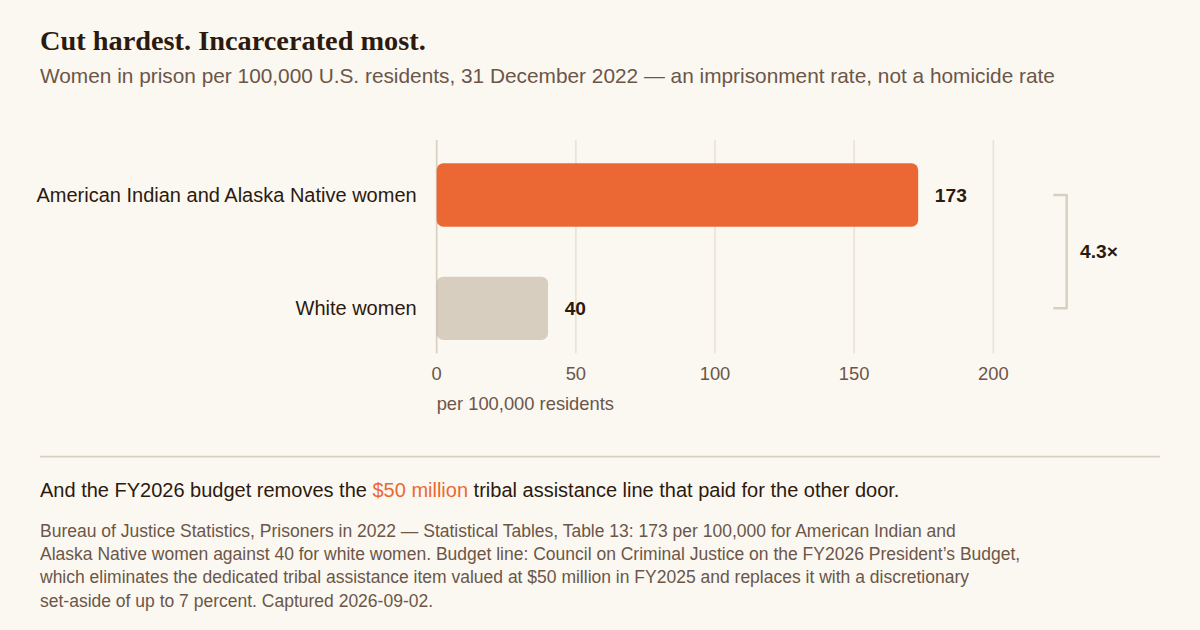
American Indian and Alaska Native women are incarcerated at more than four times the rate of white women — the population whose grants were cut hardest.
All of that is a fight over the size of a grant. It is worth remembering what the grant was answering.
WHAT THE LAW LOOKED LIKE BEFORE 1994
What existed before 1994 was a rule that the crime could not be committed. The marital rape exemption held that a husband could not, in law, rape his wife.
It came from one passage by Lord Hale in the seventeenth century — a wife "hath given up herself in this kind unto her husband, which she cannot retract." He cited no authority. He asserted it, American legislatures stamped it, and courts built on it for three hundred years. Commonwealth v. Fogerty, 1857: marriage to the victim is always a defense to rape. New York's People v. Meli, 1922, repeated Hale word for word.
It ended much later than anyone expects. New York's high court struck its own exemption in People v. Liberta in 1984, resting the doctrine on "archaic notions about the consent and property rights incident to marriage." Liberta records that in 1984, more than forty states still retained some form of it. The last states criminalized marital rape in 1993. VAWA was passed in 1994.
And it is not finished. South Carolina's spousal sexual battery statute still requires aggravated force, requires the wife to report within thirty days, and caps the sentence at ten years against thirty for first-degree criminal sexual conduct. The same act, two-thirds off, with a clock running on the woman.
Ohio closed its own in 2024 — on the fourth bill since 2019, thirty-nine years after advocates started.
A SERIES, SERIALLY
They Called It Suicide · 3 · The Roster
A law rewritten a little each year without repealing anything has a twin: a record that loses people a little at a time without anyone closing a file. Ninety-eight names, and the state's part in each of them is the same part it plays in the story above — deciding, quietly, what does not have to be investigated.
Ninety-eight people. Everyone the research team has found is listed at the case registry, including the two families who accepted the ruling once they were shown the file. One is officially undetermined. More than half the roster is still being verified.
Thirteen states and the District of Columbia are represented so far. Mississippi leads, with thirteen people — more than any other state.
Rasheem Carter was twenty-five, a contractor at a Georgia-Pacific mill in Taylorsville, Mississippi. The day before he went missing in October 2022, he told police that men were pursuing him, then called his mother to say three truckloads of white men were trying to kill him. His remains were not found once. They were found three times, in three separate discoveries over four months, all in Smith County. The Mississippi State Medical Examiner's exam found no means by which a cause of death could be reasonably determined. The sheriff's office says there is no evidence of foul play. It also has not closed the file.
Notice what that sentence can mean two different ways, and both get said the same way out loud: either the remains were intact enough to check for violence and none was found, or they were too degraded to check at all. The Medical Examiner's own language is the second one. "No evidence of foul play" is true either way you say it, and it gets said the way that sounds like an answer.
Two families out of ninety-eight stopped disputing the ruling on their loved one. Both stopped for the same reason — somebody showed them the file. Ninety-six families have not been given that. The difference between the two groups is access, not grief.

The whole argument, in one piece →
WATCH
How Oliphant Created a Legal Void
The tribal grant line is the one this budget deletes outright, not merely cuts. This clip is the fifty-year-old legal void that line was funding a patch over.
VAWA created the federal prohibition on gun possession by people under qualifying domestic violence orders and convictions.

WHAT YOU ARE A PART OF · 7
Why I Built Diosa Ara
I founded Diosa Ara to do the work the system has refused to do. Not as a company alone — as a model.
A model that centers clinical excellence, scientific integrity, and equity, in that order, and does not treat them as competing values. A model that sees women in their full complexity — biological, emotional, political, economic — and refuses to peel those apart for the convenience of a billing code. A model that does not pretend fertility is separable from family structure, or health from structural inequity, or maternal mortality from race.
We are building care, consulting, content, and community in a single ecosystem, driven by women and designed to challenge the systems that have failed women for too long. We are not interested in describing what is broken. The description is finished. We are building what comes next.
THE ASK
Where the work lands first.
The community is where the work lands first: the series, the lives, the medical lectures written in clinical context for patients and providers, the pregnancy course, and the playbooks that tell you what to do when the system will not. It is written by clinicians who have sat in the room, for the people who are about to. An account is free. The membership funds the next piece.
UPCOMING
12 October · Pregnancy & Infant Loss Awareness — Remembrance window (Oct 15)
12 October · Yemaya's Legacy — Your Health History (Live)
WATCH THE LIVES
Every live from The Economic Body is on the series site, with the deck from each one that has aired.
The Economic Body — the lives, and the deck from each one →
To see the full schedule — the Collective calendar →
NEXT
Everything I have just described happened again, in this city, to a woman who did every single thing we tell women to do.
Thank you for being here. Forward this to one person who needs the spine.
— YC
Dr. Yamicia Connor, MD, PhD, MPH · Founder & CEO, Diosa Ara | Creator & Editor-in-Chief, The Labora Collective
A Labora Collective Publication — part of the Diosa Ara ecosystem