

Viva Voce
THE LABORA COLLECTIVE · A DIOSA ARA INITIATIVE

THE ECONOMIC BODY / SEND 15
VIVA VOCE · November 10, 2026 · READ-ALOUD FROM THE LABORA COLLECTIVE
SEND 15 OF 21
Which bill to open
We were never choosing whether to spend. We are only choosing which bill to open.
DR. YAMICIA CONNOR, MD, PHD, MPH

Let me put it the way it actually behaves, because "which bill to open" is not a figure of speech. It is the literal mechanics of the thing. You know how this goes, because most of us have done it with an envelope left on the counter. The bill comes. You don't open it. You tell yourself that if you don't look, it isn't quite real yet. Maybe it resolves itself if you just don't engage. It does not. It comes again next month, exactly on schedule, because a bill is the single most reliable thing in your life. And now it is larger, because there is interest on it. You look away again. It comes again, larger again. And the day arrives when you can no longer not open it, and what is inside is no longer the number you could have paid at the start. It is that number, plus the interest, plus the penalties, plus the credit you wrecked, plus the bankruptcy, plus every consequence that trails a bankruptcy for years. You did not save the money by leaving the envelope shut. You paid many times over, on the worst possible terms, in exchange for a few months of not looking.

Open the cheap one.
For the woman I want to tell you about tonight, the envelope was the prenatal visit she never got to. What compounds inside it, month after month, is not interest. It is the pressure nobody ever took.
That is exactly what we are doing to the woman who cannot get to the visit. The appointment she cannot reach is the envelope on the counter. It costs a shift, the clinic is an hour away, no one is watching her children while she goes. We look away, and it does not resolve. It arrives anyway, on schedule: the pressure nobody ever took, then the headache nobody heard, then the emergency, then the child born to buy his mother time, then the years that child spends catching up to a start he never got to have. Every month we refuse to open it, it compounds. And notice that the word for what it does is the same one I use at the bedside for what an untreated disease does to a body over time. Sequelae.
We are not a country that weighed this care and found it too expensive. We are a country standing at the counter, staring at the envelope, telling ourselves that if we simply never open it, the woman inside it will stop being real.
The bill comes due either way. That is the part I cannot get people to sit with. We can pay it upstream, a few thousand dollars at a time, in prenatal visits and stable rent and a mother who can make it to the appointment that catches the pressure while it can still be brought down. Or we can pay it downstream, hundreds of thousands at a time, in the intensive-care bay and the special-education classroom and the six decades of a life that never got to become what it was going to be.
We were never choosing whether to spend. We are only choosing which bill to open. And every argument anyone has ever made, the tender ones and the cold ones alike, says open the cheap one.
The preterm rate is not improving
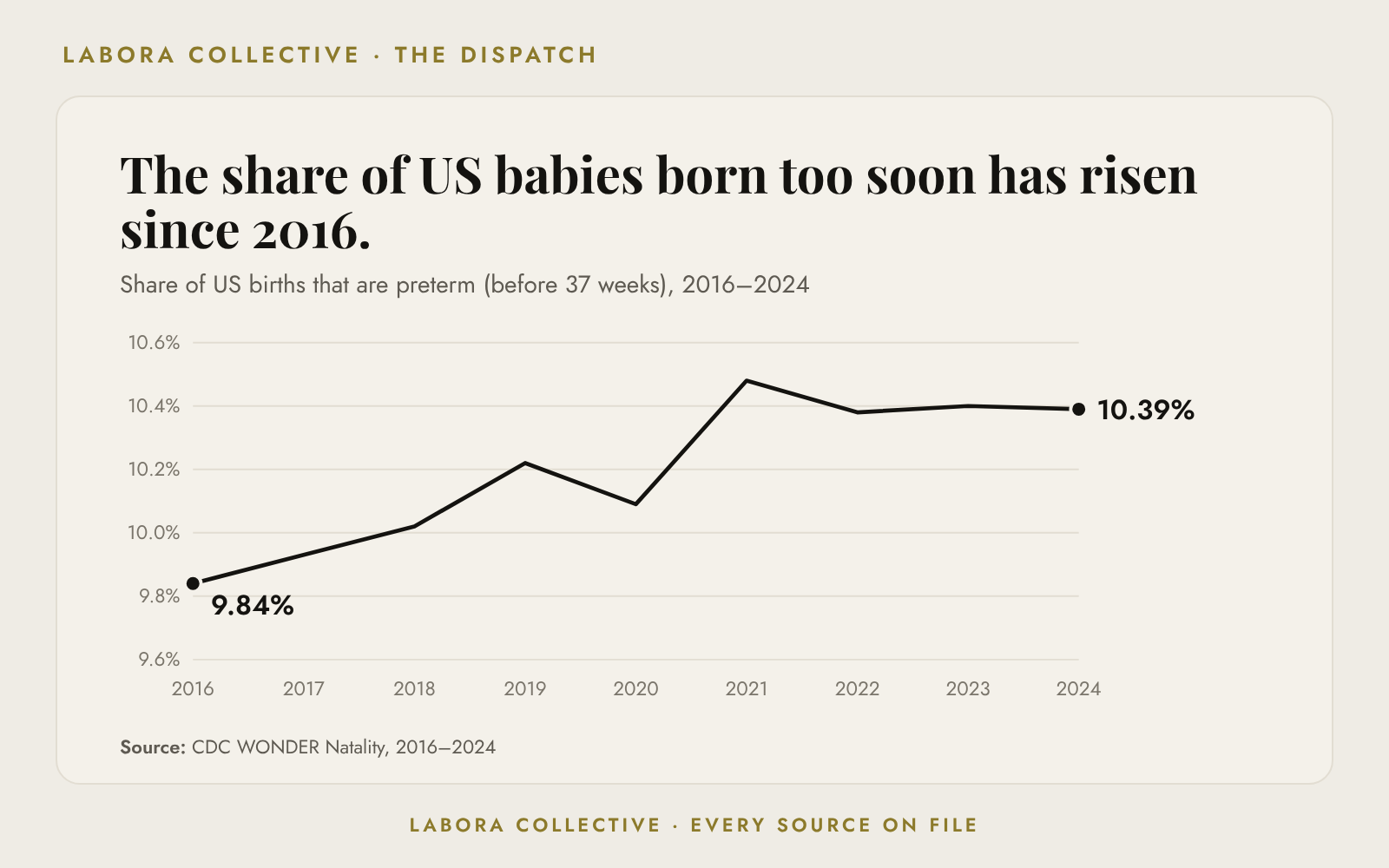
The envelope isn't shrinking on its own while we look away. Births in this country are falling. The share that arrive too soon isn't falling with them.
The US preterm birth rate reached 10.39% in 2024, up from 9.84% in 2016. Over the same period total births fell about 8 percent while preterm births fell only about 3 percent.
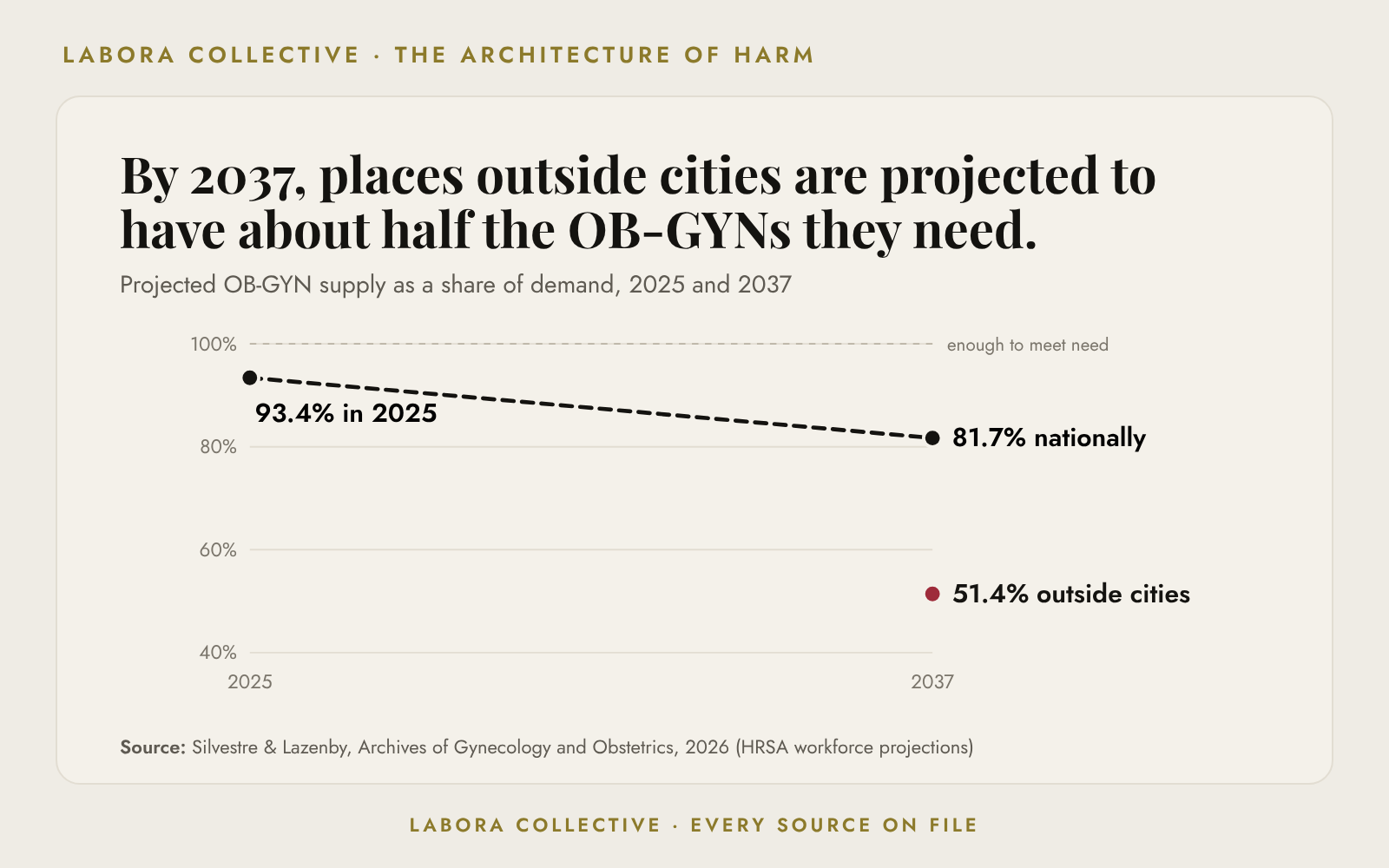
By 2037, places outside cities are projected to have about half the OB-GYNs they need
Left unopened, the compounding I just described has a date on it. This is the year the infrastructure itself is projected to fall behind the need.

WHAT YOU ARE A PART OF · 16
The System Was Not Built for Us
Women were excluded from most clinical trials until the 1990s. The justification was always biological complexity: the menstrual cycle, the possibility of pregnancy, the inconvenience of variability. The result is that we still extrapolate dosing, side-effect profiles, and disease progression from male bodies, then act surprised when women have worse outcomes on drugs that were never validated in them.
The exclusion isn't symmetric. Black women in the United States are three to four times more likely to die from pregnancy-related causes than white women. That gap doesn't close when you control for income, and it doesn't close when you control for education. The gap is racism, the everyday clinical kind, built into who gets believed, who gets imaged, who gets escalated.
We have built a healthcare system on top of centuries of erasure. We are living with the consequences and asking why outcomes are bad.
THE ASK
Written by clinicians who have been in the room.
Every clinical piece here is written by people who have managed the emergency being described, not summarised from a guideline by someone who has not. That is the whole editorial standard. Membership is what keeps clinicians writing instead of billing.
UPCOMING
9 November · Diosa Ara Medicine Live: Menopause & the Pelvic Floor
10 November · Diosa Ara Medicine Live: Gynecologic Surgery
WATCH THE LIVES
Every live from The Economic Body is on the series site, with the deck from each one that has aired.
The Economic Body — the lives, and the deck from each one →
To see the full schedule — the Collective calendar →
NEXT
Next: the woman who was standing in front of me while I did this math.
Thank you for being here. Forward this to one person who needs the spine.
— YC
Dr. Yamicia Connor, MD, PhD, MPH · Founder & CEO, Diosa Ara | Creator & Editor-in-Chief, The Labora Collective
A Labora Collective Publication — part of the Diosa Ara ecosystem